Upstairs is our sleeping loft. It's 225 sq.ft. under the roof with two twins made into a king bed. The front is open to the living room's cathedral ceiling.
The center ceiling is high then slopes down to short walls good for storage.
Come take a YouTube video tour to see for yourself.
Thanks for taking the tour today. If you have any questions, please ask. We enjoy sharing about our off-the-grid experiences. -- Margy
You've just been reading a series of posts about our float cabin on Powell Lake. It was built almost single handedly by our good friend John. He took several years off after building our cabin, but the dream of a new one for himself was strong.
Cabin Number 5 is the nineth book in the Coastal BC Stories series by Wayne J. Lutz. In it he follows along as John constructs his new float cabin from the water up. John purchased massive cedar logs and cabled them together into the floating foundation. Over the months and years, when time and money were available, the cabin grew board by board. If you've ever dreamed of living in an off-the-grid cabin, or wanted to build one for yourself, you'll enjoy reading Cabin Number 5 (yes, it's the fifth one John has built or remodeled).
Last week I shared the remodeled kitchen in our float cabin. From Summer 2011 through Spring 2012, with the help of our good friend John, we completed several float cabin improvement projects. The most involved was the addition of a bathroom and side porch.
Follow these links for details about the construction process.
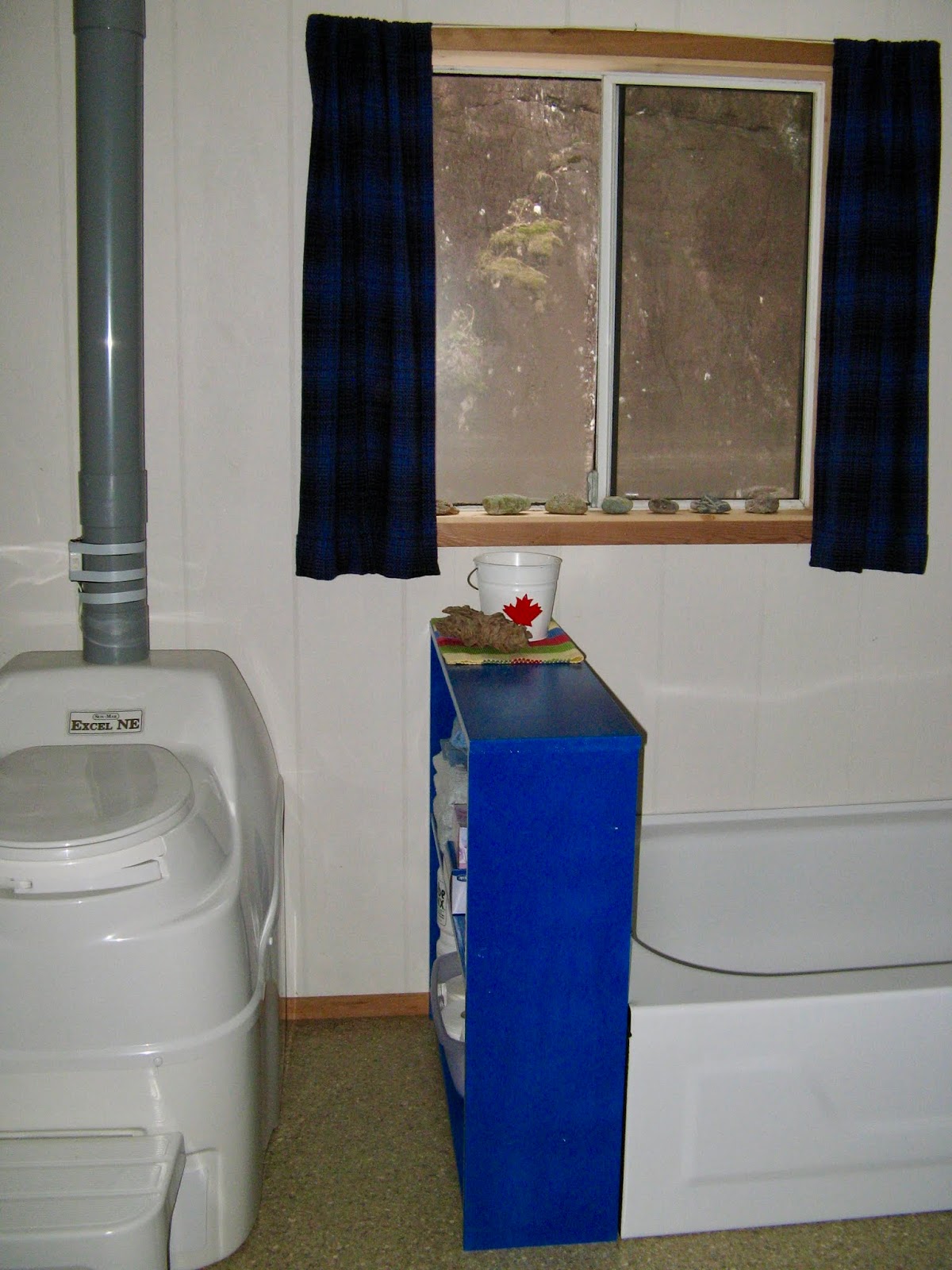
But the most welcome addition is the compost toilet. An added bonus is that it is an approved black water solution that meets our water lease requirements.
Welcome to my next installment of float cabin tours. You've been welcomed aboard and you've seen our cabin's floor plan. Today I'm taking you through the kitchen we remodeled in 2011. The biggest changes were new propane appliances and extra storage space.
Float Cabin Kitchen
We kept our L-shaped counter and sink with a hand water pump. With limited electric power, having manual and propane appliances helps.
L-counter with sink and hand water pump.
Because we live in an area with off-gridders, propane appliances are available. We upgraded to a home-sized Unique brand propane refrigerator and a larger Premier brand propane range. And John built us a custom shelf for our electronics and the storage of large pots. Here are links for more detailed information:
To save space, we eat at the picnic table on the front porch or on TV trays in the living room.
If you ask Wayne, he'll say the best upgrade is the refrigerator. We have plenty of room for milk (Wayne loves milk and cookies) and freezer space for ice cream.
Thanks for taking the tour today. Come back next week and see where guests can stay and our bathroom addition. -- Margy
Before I proceed with the video tour inside our float cabin home, here's an overview.
Our cabin is the third John built, so it's called Cabin #3. It's small enough (675 sqft) to easily maintain but large enough not to be cramped.
First Floor
The first floor has the most living space (500 sqft). There are two small bedrooms (7'x10'), one for guests (which we rarely get) and one for storage. We keep a week's supply of firewood (Wood Storage Shelf Construction) in the guest room. That's especially handy in winter.
Sink with hand pump and propane fridge.
Downstairs is greatroom style. The kitchen with propane appliances is on one side and the living room with a woodstove on the other. We have a portable TV for Internet streaming. It's compact and functional.
Compost toilet, tub and storage.
In 2011 we added an indoor bathroom off the guest room to replace our outhouse four flights of stairs up the granite cliff. This one change to our cabin made full-time living much easier.
Second Floor
The loft master bedroom with a king bed and view.
The second floor is a sleeping loft. Two twin beds together make a king. The loft and high ceiling over the living room make the cabin feel spacious. A window high on the opposite wall gives us a captivating view of Goat Island.
If we had more space it would feel like work to keep it clean and maintained. If you are planning on building or purchasing a cabin, think about that. Bigger isn't always better.
Come back next week for the next installment of the video tour. See all that we can do in a kitchen with just 130 square feet. -- Margy
In 2001, Wayne and I discovered our float cabin on Powell Lake in Coastal BC. In the beginning, we could only be here on school holidays since we were both educators. Retired we can be in our off-the-grid cabin home about 75% of the year in all seasons.
Logging Camp Photo: Powell River Museum
During the heydey of logging along the BC coast, floating cabins and shops were common. They were used for remote camps to provide homes and work platforms up rugged inlets and on large lakes. Today, float cabins are used on fish farms and for off the grid living.
Currently, there are about 250 float cabins on Powell Lake. They're spread along the 480 kilometres (300 miles) of shoreline. That makes most locations private.
Why did we choose this lifestyle?
It's unique.
Float cabins are a part of coastal history.
We wanted a place to retire that was different from our city life.
It's remote and uncrowded.
We are surrounded by nature.
We get to enjoy the seasons.
We are off the grid.
We can live a simple, tiny home lifestyle.
We like boating to our water access only home.
Town is only 25 minutes away for resupply.
There's a distributed community for support and friendship.
It was love at first sight.
Several years ago I created short video tours of our float cabin home. Here's the first in the series called "Welcome Aboard."
Since this video was made, we no longer have a stairway up the cliff and the shed on shore has been removed to comply with British Columbia water lease rules.
If you would like more information about float cabin living, here are some quick links:
This week while Wayne and I are sheltering in place in Bellingham, Washington, I'm sharing some of the birds that I would normally be welcoming to our float cabin home on Powell Lake in Coastal BC. I may not be there this spring, but I'm sure they are.
Follow the links below to learn more about each one.
One of the first to arrive in spring is the American Robin. The weather may still be cold, rainy and cloudy, but they foretell the longer days, warmer weather and blooming flowers to come.
An American Robin sitting on driftwood at the float cabin.
One of the most unusual birds that comes to visit our float cabin is the Great Blue Heron. They are frequently seen in town, especially at the marina, but each year one will come for an extended visit to our log boom to fish. They have such a distinctive prehistoric cry.
A Great Blue Heron visits our log boom to fish for his dinner.
Once we had an unwelcome spring visitor, an American Flicker. It wasn't the American part that made her unwelcome. It was her desire to drill a hole in our wall to build a nest. We chased her away, blocked the hole she started under the eaves and put up "scary" things to deter her return. It worked, but we still have a spot as a reminder.
An American Flicker tried to nest in our cabin wall.
It wouldn't be Canada without Canada Geese. They come to Hole in the Wall where there are shallow beaches to raise their families. Later they bring their goslings by the cabin and try to sneak vegetables from my float garden.
Geese pair for life and arrive in early spring to prepare for nesting.
In 2010, Red Throated Loons arrived at Hole in the Wall. They took over territory from the Common Loons that previously came to visit. They are beautiful birds and when they come into our "front yard" you can hear them coo lovingly to each other. Here a short video.
Towards the end of spring, the Barn Swallows arrive. One pair usually builds a nest under the eaves over our front porch. In the beginning, nests would fall from the narrow ledge. Wayne and I stepped in to install a platform and added a padded cushion below in case any babies fell from their lofty perch.
Mother Barn Swallow sitting on her eggs under the eaves.
I will miss welcoming these annual visitors back home. Hopefully, they'll still be there to welcome me back by early summer at the latest.
Which birds do you like to welcome back each spring to your home? -- Margy
Have you dreamed of moving off the grid and living in harmony with nature? What will it take? How do you get started? Author Wayne Lutz shares valuable insights that will inspire and assist you in fulfilling your dream.
Check with your favourite online bookseller or go to PowellRiverBooks.com for more ordering information.
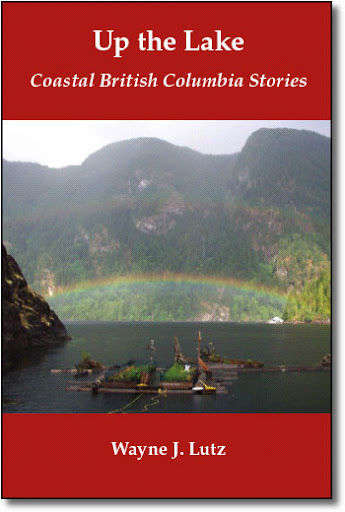
Head up Powell Lake to experience life in a float cabin, take a boat to Desolation Sound, ride a quad into the backcountry and fly overhead for a unique view of this incredible place. Read Up the Lakeby Wayne Lutz and then join us for the vacation of a lifetime. You may never want to leave.
Take a realistic look at life in a remote location where you make your own power, live in harmony with nature, and determine your own destiny. Read Off the Gridby Wayne J. Lutz and see how it works for a couple living in a Coastal BC float cabin.
Cabins float in a cut-off fjord of British Columbia’s south coast. One man tackles an on-going dream to construct a floating cabin on Powell Lake, from the water up – not his first, but his finest. Read Cabin Number 5by Wayne J. Lutz and experience it for yourself.
Travel up the main logging roads for an unparalleled backcountry experience. Whether you go by ATV, motorcycle, mountain bike, car or on foot, you can find clear mountain streams, hidden lakes and uncrowded campsites. Read Up the Mainby Wayne Lutz and ride along with us.
Stories of ATV exploration, hiking, and survival for the stout of heart and those who crave wilderness adventure. Set in remote Canada where people are isolated from the bustle of the surrounding world. Read Farther Up the Mainby Wayne J. Lutz and experience it for yourself.
Join Wayne, Margy, John, and Powell River ATV Club members as they explore the Powell River backcountry by ATV. Read Beyond the Mainby Wayne J. Lutz for ideas about where to ride or just experience this exciting sport from the comfort of home.
Join us for quad adventures to destinations on Powell and Goat Lakes only accessible by boat. Visit unique places where all-terrain vehicles can explore logging roads and trails in one of British Columbia’s most picturesque regions.
Check with your favourite online bookseller or go to www.PowellRiverBooks.com for more ordering information.
**********
Let's go "Up the Strait"
Up the Strait
Coastal BC Stories
Jump in the boat and head up the Strait of Georgia to magnificent anchorages and exciting adventures.
Go to www.PowellRiverBooks.com for ordering information.
********************************
Farther Up the Strait
Coastal BC Stories
Boating on the Strait of Georgia, British Columbia, and the islands to the north. Stories of the people and places of coastal British Columbia, where the mountains drop into the sea and lifestyles focus on self-reliance and a different sense of purpose. Read Farther Up the Straitby Wayne J. Lutz and experience it for yourself.
For the pilot and adventurer at heart. Fly high over beautiful Canadian lakes, forests and inlets. Land at remote strips and camp under starry skies. In addition to BC, travel to the Arctic Ocean, Hudson Bay, Canadian prairies and Pacific Northwest for a unique travel experience.
Go to www.PowellRiverBooks.com for ordering information.
***************************
Come to BC for Winter Fun
Up the Winter Trail
Coastal BC Stories
Your winter holiday plans won't be complete without a visit to Powell River and its uncrowded winter vacation opportunities. Hike, snowshoe, cross country ski - we have it all and more. Want a preview? Read Up the Winter Trailby Wayne Lutz.
The Powell River Books Blog is designed to promote the books written by Wayne J. Lutz. On occasion, reviews of other products or services are included as informational posts. No cash or in-kind payment has been received for any of those posts.
Cookies Notification
This site uses cookies from Google to deliver its services, to personalize ads and to analyze traffic. Information about your use of this site is shared with Google. By using this site you agree to its use of cookies. Click here for more information about Google's use of cookies. Click here to read Google's privacy policy.

 Welcome to my fifth installment of float cabin tours. So far you've been welcomed aboard, examined our floor plans, viewed our off-the-grid kitchen, and walked through our new bathroom and guest bedroom.


 Labels:
Float Cabin Living
Labels:
Float Cabin Living






 Posts
Posts


