Showing posts with label Book Reviews. Show all posts

Sunday, December 04, 2022

Book Review: "Murder Rides a Gale Force Wind" by Yvonne Maximchuk

The author/artist in action at our float cabin.
This month I'm reviewing a new book by my favourite local author, Yvonne Maximchuk. I've read all her non-fiction books about the people and places near her off-grid home in Echo Bay on Gilford Island in Coastal British Columbia. Murder Rides a Gale Force Wind is her first novel.

Yvonne is an author and artist. She's a master at capturing the beauty of Coastal BC in images and words. You can see more at her website.

Murder Rides a Gale Force Wind is set in Echo Bay, nearby islands and North Vancouver Island. If you've read any of Yvonne's other books, you'll recognize her inspiration from real-life people and places like the Echo Bay Marina and Lodge and legendary Billy Proctor.

Review of Murder Rides a Gale Force Wind

Echo Bay is a small hamlet of cabins in a protected cove cut off from Vancouver Island by kilometres of sometimes dangerous ocean. Like all small villages, everyone knows everyone, sometimes too well. Woody's lodge and marina is the heart of the community. It's usually a quiet place, except when summer boaters come to cruise the nearby scenic waterways. In all seasons, it supplies residents and fishermen with fuel, mail, supplies and gossip.

Tim is a colourful character. He's settled into being a government agent checking prawn boats for legal catches. He has conflicting love interests, Margaret an RCMP Sargent in Port McNeill on Vancouver Island, and Kit who runs a boat taxi service out of Echo Bay. There's also a tangled web of other characters from Echo Bay, the First Nations village, and recent arrivals to this isolated region.

Several story lines unfold to introduce the characters and the beautiful land and sea. They come together crashing together when a body is discovered washed up on the shore of a neighbouring island. The big question, is it murder or something else.

Yvonne knows this area well.  It's been her home for many years. Her extensive knowledge of boating, off-grid living, commercial fishing, logging, painting, First Nations, hiking and exploring shows in her descriptive narration. I'm amazed at how much I have learned over the years by living in the region. For some readers, a few terms might be unfamiliar, but add to the authenticity. 

Congratulations to Yvonne on an exciting novel. You are a master of words to paint pictures in the minds of your readers.

Murder Rides a Gale Force Wind is available in e-book and print formats from a variety of online booksellers plus several Vancouver Island and Lower Mainland bookstores. Watch her Facebook page for upcoming in-person readings and presentations.


Posts I've written about Yvonne and her books:

Yvonne Maximchuk: Painter, Potter, Author and her visit to our Powell Lake float cabin

Her memoir Drawn to Sea

Books co-authored with Bill Proctor: Full Moon, Flood Tide and Tide Rips and Back Eddies

***********************************

Would you like to own a piece of historic and scenic Echo Bay? Yvonne's custom, state-of-the-art off grid waterfront home is for sale. For details visit Realtor.ca.


***********************************


Visit the monthly Book Review Club for teen/young adult and adult fiction over at Barrie Summy's blog.

Also shared with Your the Star at Stone Cottage Adventures.

Sunday, May 29, 2022

"The Book Woman of Troublesome Creek" by Kim Michele Richardson

The Book Woman of Troublesome Creek by Kim Michele Richardson (Sourcebooks Landmark, 2019) was recommended by my husband Wayne. He's typically a scifi aficionado, but found this historical fiction novel compelling. Through extensive research, the author has effectively woven factual events into a well written tale.

They say to write about what you know. Kim Richardson grew up and lives in Kentucky, the book's setting. Her story portrays the people, places and history of the Depression era pack horse library project in Appalachia. It also brings the extreme poverty, illiteracy, and racial discrimination to life.

Cussy Mary Carter lives with her widowed father in Troublesome Creek, a hill-country coal mining town. They are descendants of French immigrants who carried the methemoglobinemia gene, causing blue skin tones. At the time, little was known about the condition. In tight knit communities, anyone different was subjected to discrimination and persecution. 

Due to her physical condition, Cussy Mary has to go behind the back of the local librarian and apply by mail to become a Pack Horse Librarian. Her mother was an avid reader and instilled in Cussy a love for books. Serving as a unique mobile librarian, she shared her love for reading and learning with individuals and families isolated by location, poverty and antiquated attitudes.

I highly recommend The Book Woman of Troublesome Creek. I learned about a part of the United States far from my homes in California and the Pacific Northwest. Living conditions were dire, women were subjected to harsh conditions and abuse, and young children often died from starvation. Yet, families endured and the pack horse library program brought a bright diversion and educational opportunity to people with few opportunities.

The Book Woman of Troublesome Creek is available in print, e-book and auditory book options online and in bookstores.

More about Kim Richardson and Book Woman: 

Kim Richardson's website.

Kim Richardson's Facebook page.

A book trailer at Kim Richardson's website.

Controversy about another book published with similarities.

The story continues with The Book Woman's Daughter.


Visit the monthly Book Review Club for teen/young adult and adult fiction over at Barrie Summy's blog.

Also shared with Your the Star at Stone Cottage Adventures.

Sunday, April 10, 2022

"Ride the Rising Wind" by Barbara Kinscote

Last week I wrote a book review about the epic cross-country horseback trip that Annie Wilkins took from Maine to California. Barbara Kingscote had a similar experience riding across Canada from Quebec to British Columbia in 1949-50. Here's a reprint of my review of Ride the Rising Wind that was posted on Margy Meanders in 2015.

***************************

I follow several Powell River friends online. One day there was mention of a book about horses, one of my favourite subjects. As a young girl in the suburbs of Los Angeles, I dreamed of having a horse of my own. My dad helped by taking me riding at a nearby stable on the Los Angeles River, which at the time was not the cement channel it is today. I always rode Flash, but I think his name was more of a joke than a description of his fleet footedness.

When we came to Powell River, I saw a brochure offering trail rides at Tanglewood Farms. I’ve never completed my desire to check it out, but when I learned that the owner Phoebe Kingscote’s mother Barbara wrote a memoir of a riding adventure from the early 1950s, I had to get it.

Barbara Kingscote grew up in Quebec in the 1940s. She too had a love of horses. Working on a small subsistence farm, she gained the experienced needed to apply for veterinary college. In 1949 when she was twenty years old, the owners of the farm moved to the West Coast, but couldn’t take their horse Zazy. The solution? Barbara would ride the black mare all the way from Montreal to their new home in Lytton, British Columbia. But just prior to departure, Charlie, the owner, gave the mare to Barbara to be her own.

Ride the Rising Wind: One Woman’s Journey Across Canada (NeWest Press, 2006) is Barbara and Zazy’s story of the massive undertaking spanning sixteen months and over four thousand miles. Barbara left with minimal supplies lashed to Zazy’s saddle and $100 in her pocket. She stopped along the way at logging camps, farms and towns to intercept mail, buy meager supplies for herself and her horse, and enjoy the company of generous Canadians all along the way.

When she wasn’t offered a loft or bedroom, the intrepid pair slept under the stars or a tarp in pouring rain. Their winter was spent working in the cookhouse at a logging camp. That was a story in itself. But come spring, the two were back on the road.

To take such a journey today seems impossible. The roads are more like freeways, the traffic even more congested. Towns and logging camps along the way no longer depend on horses, so support would be minimal. That’s one reason Barbara’s story is so compelling. Horse people dream of such adventures and opportunities. The closest I ever came was riding in the Chilko Lake area helping a dude ranch hand with the horses.

After learning about the book, I found a used copy online. And then, strangely enough, I bumped into another at the Powell River thrift store. I always stop in every week or so to see what Canadian and regional treasures I can find to add to my reading shelf. -- Margy

Sunday, April 03, 2022

"The Ride of Her Life" by Elizabeth Letts

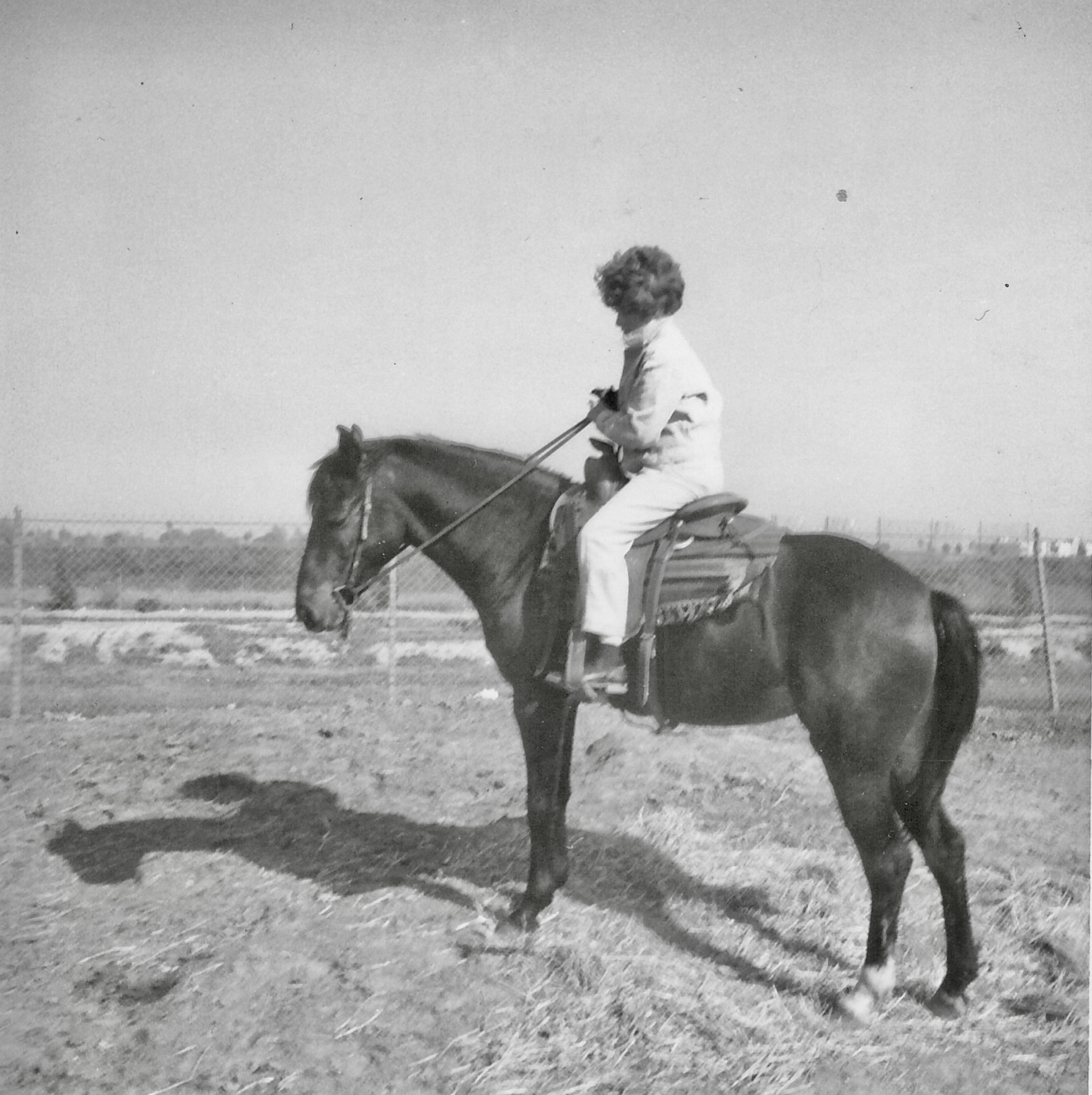
Margy (12) and Misty in 1960

Ever since I can remember I've loved horses. Mom told me about Grampa's plow horse on the Compton farm in the early 1900s.

My parents worked so Betty was my sitter. She grew up in a French chateau where they raised thoroughbreds. She told me stories about life before WWII and gave me jodhpurs she brought when she came to America.


Margy (15), Dad, Misty and baby Burke in 1963
Dad took me riding at a Los Angeles River stable. "My horse" was always Flash. I remember a movie with my little legs barely reaching over Flash's back.

I begged for a horse. My parents relented by junior high and Misty came into my life. By then the river was a cement channel, but I didn't care. My dream had come true.

This brings me to this month's review. As a kid, I read every horse book in the library. I still enjoy reading them.  I recently discovered The Ride of Her Life, the biography of Annie Wilkins by Elizabeth Letts.

Elizabeth Letts grew up in Southern California, like I did. She began riding at a young age, like I did. But she went the English route while I was a Western rider. Her love of horses has led her to write several well researched books.

The Ride of Her Life: The True Story of a Woman, Her Horse and their Last-Chance Journey Across America (Ballantine Books, 2021) is the factual account of the nearly two year journey of 63-year old Annie Wilkins, her horse Tarzan and dog Depeche Toi across America in the early 1950s.

Research included interviews, letters written by Annie to friends she made along the way, newspaper articles and television coverage.

Annie, affectionately called Widow Wilkins, grew up poor on a homestead near Minot, Maine. In her sixties, she had little savings and owed back taxes on the farm. After a hospital stay for severe pneumonia, the prognosis was only a few more years to live. Rather than giving in, she got to work and prepared for the journey of her life to see the Pacific Ocean. 

Credit: The Ride of Her Life page 278

As Annie travels, the author tells the story of America in the early 1950s. It was a time when towns were growing into cities, and roads were becoming highways. The emergence of television helped to broadcast Annie's story and built interest in her adventure.

Annie, Tarzan and Depeche Toi were successful in their quest thanks to many individuals and towns who offered lodging, meals and encouragement along the way. Arriving in Hollywood she was invited to appear on Art Linkletter's "People are Funny" TV show.

I highly recommend The Ride of Her Life to anyone who loves reading about horses, strong women, adventure and historical times. It's available in print, ebook and audio versions at Amazon and many other online booksellers.

The new Misty, Margy, Wayne and Daddy in Pomona in 1985

Before I say goodbye, here are my last two horses. During college there wasn't enough time for riding. That and my teaching career created a twenty year gap until a new Misty came into my life. (Can you guess my favourite childhood horse book?) Wayne surprised me one Christmas morning when we lived in Pomona, a childhood dream come true. And Dad was still with us to share my excitement.

Cowboy, my last horse in Pomona before moving to Powell River

After Misty came the last horse in my life, Cowboy Bich. Life moves on, but my love of horses never will. -- Margy


Visit the monthly Book Review Club for teen/young adult and adult fiction over at Barrie Summy's blog.

Also shared with Your the Star at Stone Cottage Adventures.


Thanks for visiting my post this week. I'm linking up with Saturday's Critters. Check them out for more great animal pictures.

Sunday, November 28, 2021

Book Review: "For Joshua" by Richard Wagamese

Last month I reviewed Buried Secrets in the Sgt. Windflower Mystery Series by Mike Martin. Windflower is Cree and is inspired by the works of Richard Wagamese. That inspired me to read his books.

First I read Indian Horse about the devastating repercussions residential school attendance. 

Next I chose the memoir For Joshua: An Ojibwe Father Teaches His Son.

Wagamese was taken from his parents and raised by Canadian families. He didn't learn Ojibwe culture, was bullied in school and never felt he belonged. The process became known as the "Sixties Scoop" where children were forcibly placed in non-native foster or adoptive homes. Like residential schools, it was a means to force assimilation into Canadian norms and values.

In For Joshua, Wagamese tells his life story and how he struggled to learn who he was as an Ojibwe man. Life left him estranged from his son, so he used the book to pass along important teachings.

I live in the traditional territory of the Tla'amin Nation in Coastal British Columbia. Workshops following the Truth and Reconciliation of Canada Final Report opened my eyes to past and present impacts of residential schools. Reading books by Richard Wagamese has been helpful to increase my understanding. 

Richard Wagamese was one of Canada's most famous indigenous authors. He wrote novels, memoirs and Embers, Objibwe meditations. He passed in 2017 at 61 years of age, a life ended way too soon.

Richard Wagamese's books have a Canadian focus, but forced assimilation for indigenous peoples happens in many countries. I highly recommend his works as a way to increase your understanding and get involved. -- Margy

Friday, November 26, 2021

Book Review: "Indian Horse" by Richard Wagamese

The last book I reviewed, A Perfect Storm by Mike Martin, led me to this month's book. The main character in the Sgt. Windflower Mystery series is a Cree RCMP officer. He maintains traditional practices, and reads Embers: One Ojibway's Meditations by Richard Wagamese for solace and inspiration. After reviewing books by Wagamese, I selected Indian Horse to be my first.

Indian Horse is a novel about Saul Indian Horse, an Ojibway from Northern Ontario. He was raised by his grandmother in traditional ways, but at age eight he was forced to live at an Indian residential school.

Residential schools were funded by the Department of Indian Affairs and administered by churches. Their purpose was to expunge Indigenous ways and inculcate Canadian culture. Attendance for school age children was compulsory from 1894 until an unconscionable 1996 when the last closed. 

Not only were Indigenous children ripped from their families during formative years, they were subjected to physical, emotional and sexual abuses, and too many died from harsh conditions and torture. The result is generations of First Nation peoples alienated from their culture and language, lacking education, and experiencing post-traumatic syndrome and racism.

Indian Horse takes us through this dark period through the eyes of Saul. The book opens with him telling the reader that he has been told he needs to tell the stories to understand where he is from and where he is going. As his story unfolds, we can feel his joy and sadness, his success and failure, his anguish and emergence from a blocked out horrific experience. 

Canadians are going through a reconciliation process to "redress the legacy of residential schools." In 2008, then Prime Minister Harper issued an apology on behalf of the Canadian government. That same year the Truth and Reconciliation Commission was established to hear testimony.  Their "Call to Action" was finally released in 2015.

A community traditional canoe carving reconciliation project.

Towns like Powell River across Canada brought Settlers (non-Indigenous Canadians) and First Nation members together to have hard conversations and to develop a better understanding of the ramifications of racial prejudice and subjugation. As a Settler in my native U.S.A. and my Canadian home I personally have a lot of work to do to reconcile my life of white privilege with systemic racism.

Indian Horse was the "People's Choice" Award of Canada Reads and First Nations Community Reads winner in 2012.  It's not an easy read, but the message is important especially now. I highly recommend Indian Horse and am looking forward to my next Richard Wagamese book.

Here's another book related to truth and reconciliation. Powell River is located on traditional land of the Tla'amin First Nation, a Coast Salish tribe. Written As I Remember It by elder Elsie Paul tells about this same period of time from a local perspective. 

Raised by her grandparents and hidden from authorities during fall sweeps, she was forced to attend the Sechelt Residential School at age ten. He memoir includes Tla'amin Nation history from oral traditions to the present as her people move away from Indian Act control to a self-governing nation. 

 Both books are available online including Amazon. -- Margy

Monday, November 01, 2021

"Buried Secrets" by Mike Martin

This month's review is about Mike Martin's eleventh book in the Sgt. Windflower mystery series. Buried Secrets continues the story of Newfoundland RCMP Sgt. Winston Windflower.

Mike's mystery books are different from most police-based novels. The reader gets to know the officer as a family man in addition to his official duties. And the rural Grand Bank, Newfoundland, setting gives an additional hometown feel.

While each of Mike Martin's books can be read as a stand-alone, it's helpful to read the series in order. References to previous cases and family activities have more depth if you do.

In this book, Sgt. Windflower is investigating the death of a retired minister. The case draws Windflower back to Grand Bank from a special duty assignment (Book 10) in St. John's, the capitol. Covid also plays a minor role in the story. As Winston delves into the buried secrets surrounding the minister's demise, he encounters several societal issues including drug abuse, human trafficking, embezzlement, vehicle-moose accidents, and sexual harassment within the ranks of the RCMP.

On the family side of the story, we follow along as Winston and his wife Sheila raise their two young daughters. Each night they read the girls bedtime stories. One was Brown Bear, Brown Bear, What Do You See? by Bill Martin, Jr. When I taught kindergarten, it was a favourite with my students for it's repetition and colourful pictures.

You can find Buried Secrets in print and Kindle e-book formats at Amazon.com, Amazon.ca, !ndigo and Ottawa Press. If you are a Kindle Unlimited reader, it's available there as well. Speaking of Kindles, Wayne and I just received our new Paperwhites. Our old 2010 Kindles that have served us so well are losing their cellular download capability. I'm proud to stay that Buried Secrets is the first book to be read on my new device.

One last bit of news. Mike just released a post on his Facebook page about his Reading Equity Program. You can read more about it here. I applaud Mike for giving away twenty-five free books to individuals who cannot afford to purchase one of their own. As the Children's Literacy motto goes, "Reading is Fundamental." Good for you Mike. -- Margy

Monday, September 06, 2021

"River for My Sidewalk" by Gilean Douglas

Between our float cabin and the granite wall there's a protected pool. In summer, the water is warmed by the reflect sun, making a natural heated swimming pool. 

The water can reach 24ºC (76ºF). It's a perfect spot to sit in a floating chair to read. I usually read on my Kindle, but in this watery environment I choose print backs. I find a good selection of at our local used bookstores, thrift shops and the Powell River Kiwanis Club book sales.


A memorable read from this summer was River for My Sidewalk (Sono Nis Press, 1984) a memoir by Gilean Douglas. It was first printed by J.M. Dent and Sons in 1953 under the male pseudonym Grant Madison. They thought customers wouldn't believe a woman could live alone in the wilderness and wouldn't buy the book. Gilean continued as Grant Madison until 1983, with the majority of her works first printed under that pseudonym.

Gilean was born in 1990 in Toronto into a privileged life. That changed dramatically when she was orphaned at sixteen. She married several times, traveled extensively and worked as a photo-journalist. In 1939 she moved to British Columbia and began living off-the-grid in remote cabins. There she continued working as a journalist, author and poet.

I got a signed book.
River for My Sidewalk is about her years living in an old miner's cabin on the Teal River near Duncan on Vancouver Island. She gardened, fished and gathered foods from the land. Few visitors were invited to stay, and her elevated hand pulley river crossing kept most fishermen and hunters away. She shared her land and life with animals including Grampa Cougar.

Gilean was an adventurer willing to give up an easy life to experience the wonders of nature. The tales of her experiences cut across time. There are still places where you can live a simple life, if you are willing. 

In 1947 her cabin burned. She married again and moved to Cortes Island, up the coast from my Powell River home. After her marriage ended, she remained on her 138 acre waterfront off-the-grid homestead and lived there until her passing in 1993.

Uganda Passage near the location of Gilean's Cortes homestead.

Do you like to look for old and unique books in used book and thrift stores? What are some of your best discoveries? -- Margy

Sunday, May 30, 2021

Book Review: "The Age of Great Dreams: America in the 1960s" by David Farber

On January 1, 1960, I started the new decade lying on the den floor of our Compton home, eyes glued to the TV. We always watched the Pasadena Rose Parade. Then it was Rose Bowl football, especially when USC (Dad's university) or UCLA (Mom's) played. We were a family of tradition, and I've carried many of ours into my adult life. I was in elementary school, Eisenhower was president and in my young mind all was well.

My last book review was The Fifties. I'm following that with The Age of Great Dreams: America in the 1960s by David Farber. Like The Fifties, this book is organized by major events and themes. It paints a picture of life, culture, economics, politics, science, race relations, and warfare through the decade.

On the right, ready for Camp Fire Girls camp.

While I enjoyed childhood activities, the Nixon-Kennedy election contrasted past values with new ideas. I remember Kennedy's motorcade while family camping in Yosemite. Racism was prominent in Compton and the Watts riots weren't far away.

Christmas with Mom and her extended family.

The first international event I remember was the Cuba missile crisis. It seemed far away, but scary. My parents didn't shield me from world happenings, but they weren't a major focus in our home life. Family support and interactions were at the forefront. It's a value I hold close to my heart.

In college for me, 49er Days rather than protests.

Sixties culture matured during high school and college. Campaigning for Bobby Kennedy clashed with my father's political views. Hearing about the shooting live on my bedroom radio was a huge shock. The Vietnam War and a potential nuclear attack were pressing concerns. 

The 60s for me was a mix of fun and determination to excel in school. What I didn't perceive then was how much I grew up in white privilege. Recent events here in Canada and the United States have brought this into focus. I can't change my past, but I am determined to acknowledge it and work to help and support others however I can. -- Margy

Tuesday, February 02, 2021

Book Review: "The Fifties" by David Halberstam

Our Compton home built in late 40s.
The political and social events of this past year got me thinking, were things really better when I was a kid? My formative years were in the 50s. I grew up in Compton, California, a suburb of Los Angeles. There were still dairies between expanding housing tracts and the Los Angeles River ran free. From my point of view, the world was a settled place and my family was doing well.


My current interest (and sometimes dismay) in U.S. politics instilled a desire to know more about the past. To learn more, I chose to read The Fifties by David Halberstam, author and Pulitzer Prize-winning journalist for the New York Times.

The Fifties was first published in 1993. In it, Halberstam chronicles key events from the decade with photographs, a list of interviewees, an extensive bibliography, end-notes and a detailed index. As a history major, I found it well researched and well written.

Halberstam set the stage for the 1950s by reviewing the effects of the Depression and World War II. Rather than use a sequenced approach, he presented information in themes such as politics, emerging businesses, housing, television, the arts and movies, the bomb, the Cold War, civil rights and much more. Each theme dovetailed with other events to create a unified picture of the times.

Camping was inexpensive and fun.

Many of the names and events were familiar, but the details were fuzzy. I do remember the 1952 election and saying "I like Ike." I don't remember eating at McDonald's until the 60s, but do remember hamburgers from the Beany's drive-in. Cars were important for my parents to get to teaching jobs, and for summer camping trips. I remember bomb drills at school and seeing a mushroom cloud while on a trip through the Nevada desert.

It was disheartening to read how politics haven't changed all that much. I had hoped to read about bipartisan cooperation, but that wasn't the norm then either.

I wouldn't trade growing up in the fifties. For me they were good years spent in a good town with good friends and great parents. They were important years in determining the adult I would become. Were you growing up in the 50s? How were those years for you? -- Margy

Thursday, December 31, 2020

2020 Year in Review

2020 has been like no other year, filled with stress, fear and isolation worldwide. After an Arizona RV trip, Wayne and I chose to self-isolate in Bellingham until July. Many of my posts included "throwbacks" to better times in our float cabin home on Powell Lake. 

Click the titles to read the complete posts.


1. Dancing in Gumboots by Lou Allison and Jane Wilde -  I read more in 2020. Did you? I like books written by women who homestead or live off the grid. Dancing in Gumboots is an anthology of stories by women who came to live in the Comox Valley on Vancouver Island during the 1970s.

Related post: Gumboot Girls by Lou Allison and Jane Wilde was the first anthology of stories by women who settled in Haida Gwaii (formerly Queen Charlotte Islands) and Prince Rupert in the 1960s.


2. Throwback: A Perfect Day Up the Lake -  We finally got back to our float cabin home in mid-July. We were in Bellingham when the U.S./Canada border closed due to COVID. Getting home was wonderful even with a 14-day mandatory quarantine.

Our Powell Lake float cabin home.

Related post: Goin' Home, I'm Goin' Home tells about our most unusual border crossing and the COVID quarantine we completed up the lake.


3. Throwback: Spring Gardening - We missed spring planting up the lake this year. I shared a throwback post about how my floating garden started.

My floating garden in late spring from a previous year.


Related post: What a Difference a Year Makes shows how overgrown and gone to seed my floating garden was when we returned home in July.


4. Refreshing Sourdough Starter - In the first days of the pandemic and yeast was in short supply, making sourdough bread was big thing. I left my starter in the Powell River condo fridge. It had to wait six months for a proper feeding. Amazingly, it refreshed easily and was ready for a new batch of tasty bread.

Active yeast bubbles formed while warming in the kitchen. It's ALIVE!


Related post: Improved No-Knead Sourdough Bread gives you tips I've learned to make easy and tasty sourdough bread.


5. Do you have a kicker?  We made it to Powell River in time for some summer cruising. We socially distanced at marinas and on shore. But we had a few challenges: a leaky new head (toilet), I broke my little finger, and the leg that propels our Bayliner 2452 malfunctioned. Six hours later, and after dark, we limped into Powell River using our emergency kicker motor. Due to COVID back orders, we are still waiting for a replacement.

Putting along at 4.5 knots with the kicker.

Related post: September Cruisin' takes you along on some of our successful summer cruises and a peek at my "busted wing."


2020 was hard, but we had each other for support. We hope 2021 will bring better times for all. -- Wayne and Margy

Sunday, December 06, 2020

Book Review: "Christmas in Newfoundland" by Mike Martin

Christmas is approaching, so I'm sharing a Christmas book written by my favourite Canadian author, Mike Martin. I discovered his Sgt. Windflower mystery series through Linda at Crafty Gardener. Here's a guest post Mike did for her blog.

Christmas in Newfoundland: Memories and Mysteries is part of the Sgt. Windflower series. It includes heartwarming stories with the series characters, and personal memories about Christmases past.

The theme of each story is the wonder, spirit and caring of the Christmas season. I enjoyed hearing how Sheila and Sgt. Winston Windflower celebrated the season in Grand Bank, but I found the chapters about Christmas remembrances from the perspectives of children and seniors who lived in Newfoundland the most interesting. I'm pretty sure some came right from Mike's own life.

I've been to Newfoundland twice. I've been to St. John's but never Grand Bank. It was heart warming to read about how families celebrated this special time of the year in times past and small towns.


I'm an only child and grew up in Compton, California. We always traveled to Modesto to spend Christmas week with my grandparents. I loved visiting their country home and learning about our family's Swedish and Norwegian heritage through foods and traditions.

Christmas Eve is very special for us. Wayne and I were married in front of the Christmas tree at my parent home in Sun City. What could be a better present to give and receive?


Mom and Dad taste testing the turkey in 1990.


Wayne made a childhood Christmas dream come true soon after we were married. As a child, I always hoped to find a pony on the front lawn. At 35 years of age, Wayne walked me to the stable near our Pomona home on Christmas morning to introduce me to my very own Christmas horse, Misty. What a huge surprise.

Thanks Mike for inspiring me to think back to Christmases past to find and relive the joys they brought in my own family.

Enjoy the season by curling up with an inspiring Christmas book. You can find Christmas in Newfoundland in print and Kindle formats at Amazon.com and Amazon.ca.  -- Margy

Sunday, August 30, 2020

"Wild Fierce Life" by Joanna Streetly

I find great books by local British Columbia authors in the retail shop on BC Ferries. It takes two ferries to travel between our home in Powell River to Bellingham.

Recently I purchased Wild Fierce Life: Dangerous Moments in the Outer Coast (Caitlin Press, 2018) by Joanna Streetly. If you've read my previous reviews, you know I enjoy books by and about women who live in remote locations, especially Coastal BC where I live.

Joanna Streetly grew up in Trinidad. At 18 she came to Vancouver to attend Capilano University to study Outdoor Recreation and Leadership. As a part of that program, she obtained a practicum position at the Wickaninnish (Kwisitis) Interpretive Centre in Pacific Rim National Park on the rugged west coast of Vancouver Island.

Long Beach in the Pacific Rim National Park.

Following her practicum she moved 40 klicks north to Tofino, a fishing, logging, tourist and surfing hub. She put her outdoor skills to work as a kayak guide and on whale watching tours. She's lived in town, land cabins and what I like best, float cabins. Almost thirty years later she still lives in a Tofino floathome with her partner and daughter.

Tofino's float home community at Strawberry Island.

Wild Fierce Life is a memoir of memorable, exciting and sometimes life threatening experiences. Each chapter gives the reader a peak into what it's like growing and maturing in a rugged land and ocean environment. You can read more about Joanna at her website.

Vancouver Island's rugged west coast.

 I thoroughly enjoyed reading Wild Fierce Life while floating in the natural "swimming pool" at my float cabin on Powell Lake.  It's not as remote or rugged as her float cabin location in Maltby Sough, but the concept is similar. Joanna is an artist. Each chapter is illustrated with a map (which I wish more authors would do) and wildlife images. 

The Tofino coast, a surfers haven.

Read Wild Fierce Life for a glimpse of what love, life and wilderness exploration is like in a unique coastal environment. It's available in print and ebook formats online at the following booksellers. -- Margy

Caitlin Press - Her Publisher
Amazon.ca (print and Kindle apps and readers)
Amazon.com (print and Kindle apps and readers)
Barnes and Noble (print and Nook readers)
Apple Books (through the Books app)
Kobo (for Kobo apps and readers)

Other books by Joanna Streetly include:

Silent Inlet is a fictional story about a small town on the west coast of Vancouver Island.
Paddling Through Time is the account of a kayak adventure through Clayoquot Sound.

Sunday, February 02, 2020

"Dancing in Gumboots" Edited by Lou Allison and Jane Wilde

Have you wondered about what life would be like if you had taken a different path in your youth?

Books like Gumboot Girls and now Dancing in Gumboots make me think? Both are anthologies of memoir vignettes by women who moved to Coastal BC in the 60s and 70s. Their stories are opposite to my choice.

I followed my conventional upbringing until I retired. It was then I followed my heart and moved to live off the grid in Coastal BC.

Dancing in Gumboots: Adventure, Love and Resilience - Women of the Comox Valley (Caitlin Press, 2018), edited by Lou Allison and Jane Wilde, follows in the footsteps of Gumboot Girls.

Dancing in Gumboots shares the lives of 32 women who followed their hearts and dreams in the 70s to Vancouver Island's Comox Valley and the nearby Gulf Islands.
We spent the summer together on the boat, exploring the islands and bays and sailing the straits of Barkley Sound. Brenda Dempsey in "Beyond the Valley"
There is a safe way to be awakened: hook up with another like-minded soul. Josephine Peyton in "Quest for Community"
We gathered oysters, dug for clams and fished. Parksman Pete ran the campground and, from time to time, he'd give us odd jobs to help stretch the dollars. Monika Terfloth in "I Took the Scenic Routes "
Friday was mail day, and all the cabin dwellers came into town for supplies and to get together with friends at the Likely Hotel. Gwen Sproule in "Home is Where the Heart Is"
After every spring season, we set up another camp, this time at the Courtenay Fairgrounds, where we staffed the kitchen for the annual Renaissance Fair. Cara Tilston in "Finding Home"
Many of the youthful arrivals to the Comox Valley have remained in their adopted community. You can read more about these amazing women at their Gumboot Girls Facebook page.

Powell River and Lund also had an influx of adventurous young people during the 60s and 70s. Here are some of their stories.

The Eden Express is a memoir by Mark Vonnegut, the son of famous author Kurt Vonnegut. Mark purchased vacant rural farmland near Powell River that became a haven for people who wanted to get back to the land and live a simple life. It later became Fiddlehead Farm, a hostel for like-minded people.

In The Way Home, Terry Faubert tells her story about coming to Lund, north of Powell River, and building a home for herself and her son. It wasn't easy for a single mom. I was honoured to be asked to help during the editing process of this memoir by a friend from the Powell River Gardening Club.

Adult Child of Hippies was the story of Willow Yamauchi growing up in Lund, a magnet for young people during the hippie and draft dodger movement.  Willow became a CBC Radio producer and interviewed me for about my float garden. The book is full of pictures from that period of time.

The End of the Road was a film recently produced by a Powell River area local Tai Uhlmann about the Lund counter-culture era.


We saw its premier at our local historic Patricia Theatre.

Did you come of age during the 60s and 70s? How did you approach those years? Did you maintain a conventional lifestyle or participate in the counter-culture movement? No matter which you chose, would you have done anything different then or now? -- Margy