Showing posts with label Fungi. Show all posts

Sunday, January 06, 2019

Coastal BC Fungi: Late Fall Specimens

A moist environment leading to West (Hammil) Lake.
On our quad ride in the Duck Lake region of Powell River in early December we came across fungi, some young and some old.

I'm not able to identify some of them, maybe you can help. And if I've made a mistake, please let me know.

A Coral Fungus (genus Ramaria) found on the Blue Trail Connector .

Next is a bracket fungus called Artist's Conk (Ganoderma applanatum) found nearby on the Blue Trail Connector. It got this common name because it's a favourite with artists for painting and etching when dried.

I'm not sure if these are young Artist's Conks on the downed tree or some other type of bracket or shelf fungi. They are growing out of the cambium layer of a dead hemlock (I think).

Our ride also took us to West (Hammil) Lake. You can reach it from several directions, but we used a trail to the north side near a creek and marshy spots. I don't know what this mushroom is called, but there were clumps of them near the creek on moist spots. It's looks like an old specimen whatever it is.

Another old specimen from the same location. Looks like it's tasty for some critters or slugs.

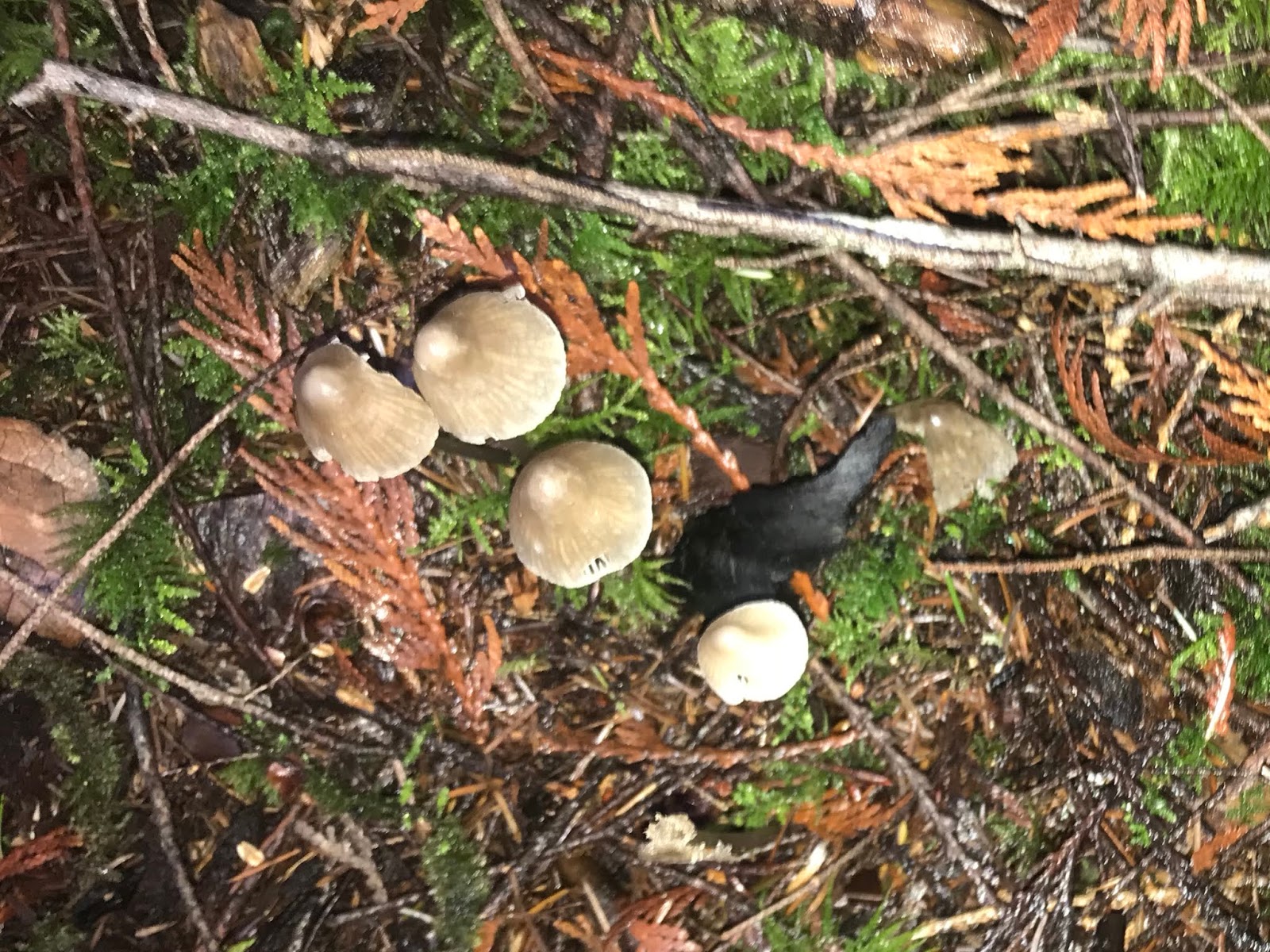
These small, pointed capped mushrooms were growing in a cluster nearby among dried needles and moss. Does anyone have an idea about their identification?

And this one was flipped over showing the intricate gills.


I'm not knowledgeable enough to be a mushroom forager. But I am an avid fungi observer. How about you? -- Margy

Tuesday, November 14, 2017

Coastal BC Fungi: Fly Amanita

Fly Amanita

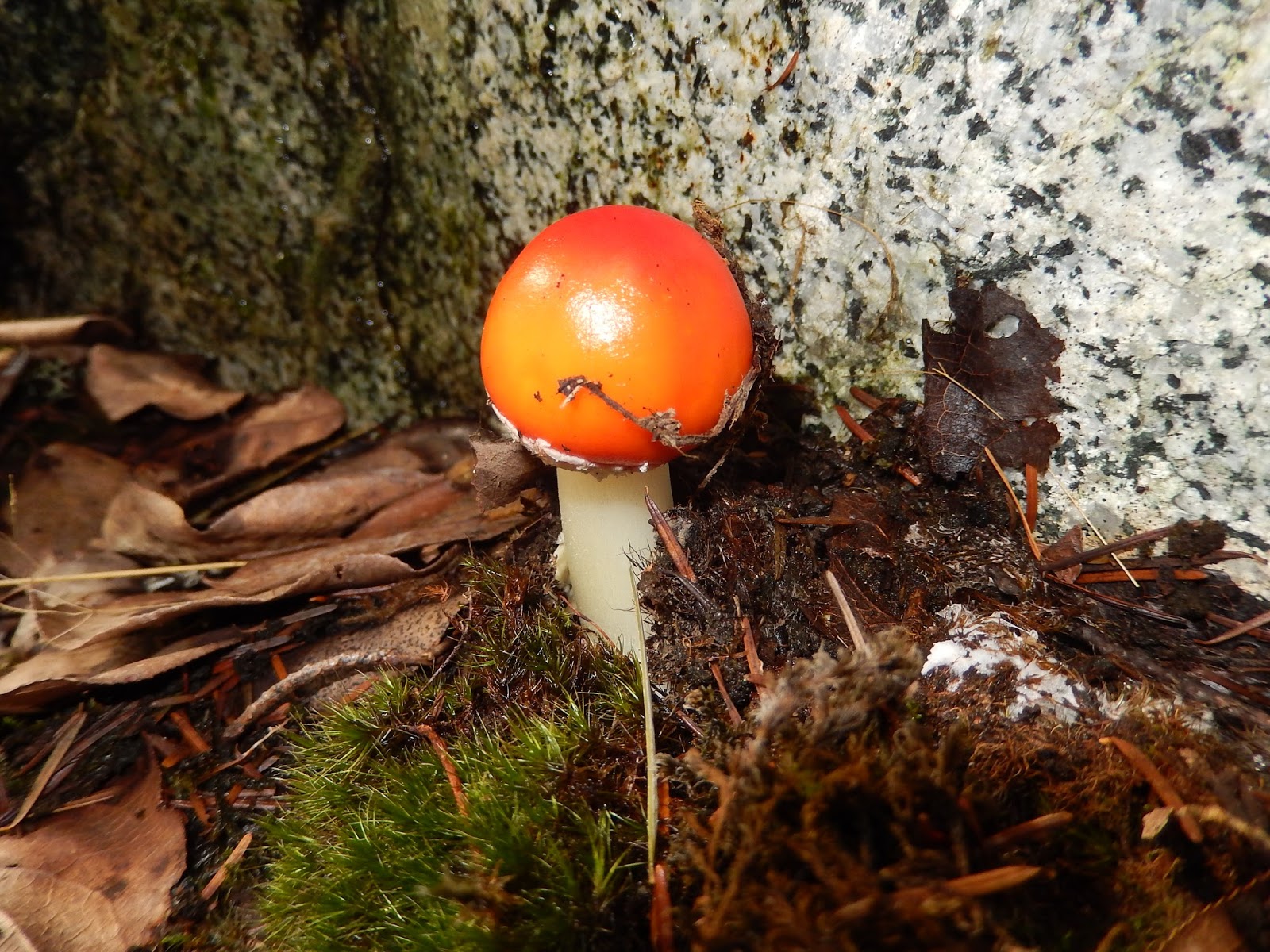
Fly Amanita mushroom, Powell Lake BC.
You can tell it’s mushroom season in Powell River when buyers arrive and ‘shroom shacks pop up in storefronts as fast as their namesakes.

I was walking up the cliffside stairs twhen I saw a red “ball” next to the steps. My first thought was a critter raided my compost pail and dropped a ripe tomato on its way up. My second thought was, it’s October and there are no more tomatoes, even in my garden clippings.

A small Fly Amanita also called Fly Agaric.

When I got closer I noticed it was a round, red mushroom. I’ve never seen one like it before. I went online to Google images and almost immediately found it, a variety of Amanita with the scientific name of Amanita muscaria, more commonly Fly Amanita or Fly Agaric.

Surrounded by moss and decaying Salal leaves

Fly Amanita is one of a family of poisonous gilled mushrooms. It’s easy to identify and avoid with its red, orange or yellow cap. It starts rounded then flattens out and turns up as it matures. Around the edge, and across the surface, are cream-coloured to white spots or warts.

Side view showing white spots or warts.

The immature one I found was about an inch in diameter, but they can reach up to twelve inches across when open. I went back to get a picture of the mature state, but alas, some animal had eaten it down to the ground. I guess the toxic components aren’t deadly to all critters. Animals usually know not to eat poisonous things.

One mushroom all alone next to the stairs.

The Fly Amanita is most commonly found in or near coniferous forests during the fall. It’s well known as the mushroom depicted in fairy tales. The unusual common name comes from the belief that you can make a product that will kill flies.

Have you ever seen a Fly Amanita? What do you think? -- Margy

References: The Savory Wild Mushroom by Margaret McKenny (University of Washington Press, 1971) and First Nature (online).

Wednesday, April 05, 2017

Coastal BC Fungi: Mitrula elegans (Match-stick Fungus)

 Match-stick Fungus

I live in a float cabin on Powell Lake in Coastal BC. Each year, a tiny plant appears right at the waterline on one of our cabin's cedar float logs. This year there are better specimens on a boom log.

On the cabin, it grows in the shade. On the boom log, it is in full sunlight. It has a white stalk and is topped with a yellow-orange fruiting body. It's only about 6 mm (1/4 inch) tall. It appears in April and is gone when the weather gets warm.


After a bit of searching I found the UBC (University of British Columbia) Botanical Garden and Centre for Plant Research website. If you like plants in nature or the garden, this is the place for YOU! There's also a forum with a wealth of information.

I discovered my mystery plant is Mitrula elegans, match-stick fungus. Here is a link I found for a picture and detailed description. I just love learning new things about this wonderful place I live in. -- Margy

Wednesday, November 16, 2016

Coastal BC Fungi: Elfin Saddle

Elfin Saddle

Elfin Saddle with covered compost pit in background.
I haven't been up to my hillside potato patch since I dug them in early October. At that time, I dug a big pit and emptied my compost barrel inside. Last week I went up to add garden trimmings and saw a black mass on the ground. My first thought was a bear had come to partake of my compost. Instead, I discovered was an unusual mushroom.

A clump of Elfin Saddles, one with a stem showing.

It was an Elfin Saddle (Helvella lacunosa). It's also known as a Slate Gray or Fluted Black Elfin Saddle. It was obviously old by mushroom standards. The black irregular cap was intact, but the stem had holes and was bending over. Elfin Saddles are usually solitary. When I looked nearby I found two more.

The large mass at the side shows a stem that has collapsed.

They are often found in disturbed ground (like my compost pit). They are common in Europe, eastern and northern North America, and along the west coast. The caps can be white to blackish gray with a folded, convoluted shape (kind of like bear poo at first glace). The stem is very distinctive with long, grooved ribs and holes indenting the surface.

Another specimen in a nearby thicket, also old and collapsed.

They appear in fall after heavy rains. October for us was extremely wet with many downpours. They prefer Douglas fir forests or areas of older brush. Mine were at the edge of the forest.

A closeup of the stem showing ribs and holes.

References say it is edible, but only young specimens and if cooked. Older ones can have poisonous properties. Caution is also given to be careful in identification because it can be confused with other poisonous varieties.

Here is a video by Richard Powell discovering a patch of Elfin Saddles on Vancouver Island. He's an amateur mycologist (he studies fungi) and has a very interesting blog called 100 Mushrooms on Vancouver Island. In addition to pictures, he includes lots of videos.


And here's an interesting tale about a mushroom hunt involving Elfin Saddles (Helvellas) by Anna at Crazy about Mushrooms. -- Margy

References: The Savory Wild Mushroom by Margaret McKenny and revised by Daniel E. Stuntz (University of Washington Press, 1971), and www.MushroomExpert.com (online).

Thursday, January 28, 2016

Coastal BC Plants: Floral Pixie Lichen

Floral Pixie Lichen

Look at just a square metre of the forest floor you will find a multitude of plants crowding together for nutrients, moisture, sunlight, and protection from the elements. Up on the cliff under the canopy of cedars and firs I found this clump of Cladonia bellidiflora also known as Floral Pixie and Cup Lichen.

Lichens are part plant, and part fungi. They are algae or cyanobacteria and fungus living as a symbiotic, composite organism. That makes them a bit tricky to classify.

Cladonia bellidiflora (Floral Pixie) in the middle.

I found these in mid-March before the bright red fruiting bodies appeared on top. In addition to British Columbia, they can also be found in Britain and many other parts of the world.

This type of lichen stands erect, is conical in shape, and tapers towards the top. To me they look like miniature pine trees in a green meadow. On close inspection you may see small cups at the tip, showing that it's a member of the cup lichen family. The colour ranges from blue-green to yellow-green. -- Margy

Wednesday, April 22, 2015

Coastal BC Fungi: Orange Peel Fungus

Orange Peel Fungus

When Wayne and I took a quad ride, the roads seemed to be littered with bright orange confetti. When we stopped to consult a map, I found the source. It was a fungus growing right out of the rocky soil.

Some were tiny and growing in clusters, but some were several inches across. They are called Orange Peel Fungus, a very appropriate common name. They look like just like bright orange peels curled up on the ground. The scientific name is aleuria aurantia. It's a cup fungus that likes to grow in clay soil, disturbed areas, and along road cuts and banks.


Orange Peel Fungus lives on and decomposes organic matter, ultimately enriching the soil where it grows. You can look for it during summer and fall in most North American locations. -- Margy

Tuesday, April 07, 2015

Coastal BC Plants: Methuselah's Beard Lichen

Methuselah's Beard Lichen

In our moist climate, mosses and lichens grow in profusion. You see many trees encased and draped with these non-vascular plants. One impressive lichen is called Methuselah's Beard (Usnea longissima). As with all lichens, it is a composite organism with both plant and fungus characteristics.

It hangs from trees in long masses that make you think of the Old Testament patriarch who was reported in the bible to have lived 969 years. These beards aren't that old, but look like they've grown for a very long time.

Methuselah's Beard (click here for a fact sheet) used to have a much wider distribution around the world, but it has been declining due to habitat and environmental changes. It is still common along the Pacific region from Northern California to Alaska. Even where it remains, it has a spotty distribution, possibly related to its asexual reproduction through fragmentation of the thallus base.


It's most frequently found on old growth and mature conifer and hardwood trees in forests with high humidity such as coastal ranges. As these trees are harvested, the habitat is reduced.

The colour ranges from pale green to a yellowish-silver tint. This closeup with flash made it turn white.

First Nations people and herbalists have used it for purported antiseptic and antibiotic properties, but because of its tenuous status, harvesting or damage should be avoided. -- Margy

Wednesday, January 14, 2015

Coastal BC Fungi: Artist's Fungus

Artist's Fungus

Here's a tree that caught my eye because of the fungus growing up its trunk. I believe the tree was a fir, and it was healthy looking. There were so many fungi, and they ranged all the way from the roots up to about fifteen feet. Doing some research online, I believe it is Granoderma applanatum, more commonly known as shelf fungus or artist's fungus. It's called artist's fungus because carvings on the white underside will darken to create scrimshaw-like images.

The tops were brown, almost the same colour as the trunk. The undersides were a brilliant white.

To me, these two merged fungi look like pursed lips. You see, even Mother Nature can be an artist. -- Margy

Wednesday, November 12, 2014

Coastal BC Plants: Reindeer LIchen

Reindeer Lichen

Lichen is made up of a combination of organisms.  All lichens include a fungus plus an algae and/or a photosynthesizing bacteria in a symbiotic relationship. Lichens are plant like, but not technically plants. Lichens cling to plants, rocks, logs or soil, but they are not parasitic. Because of their unique nature, they create their own food from sunlight, air, water and minerals.


A common form of lichen in Coastal BC is Reindeer Lichen. There are many different varieties ranging in size and colour. The Reindeer Lichen on our granite cliff if off-white, erect and forms flowing mats, especially at this time of year.  I'm not sure which variety I have, but I think it might be Cladonia rangiferina.


When winds and rains are heavy, clumps of Reindeer Lichen break free and wind up on the stairs or water. I pick it up to use as mulch. In winter, it gives by decorative plants some protection from frost. In summer, it helps hold in moisture during dry weather. Besides it's mulching properties, it's gives the cliff lots of bright contrasting colour during the gray winter months. -- Margy

Wednesday, September 17, 2014

Coastal BC Fungi: Orange Jelly Fungus

Orange Jelly Fungus

Take a hike in the forest and you might find some Orange Jelly Fungus.


Orange Jelly Fungus is a very appropriate common name. It looks just like orange marmalade oozing from the cracks in a log. Another common name is Witch's Butter. Dacrymyces palmatus is its scientific name. The website says it's edible, but I think I'll pass and not spread it as butter or jelly on my toast.

(Never eat a mushroom or fungus unless you are absolutely certain of its identity. There are many look-alike varieties, and some are poisonous.) -- Margy
unless you are absolutely certain of its identity!

Tuesday, December 18, 2012

Coastal BC Plants: Mushrooms

 Mushrooms

This time of year, mushrooms are big business in Powell River.  Locals and visitors alike comb the forest floors for edible shrooms such as Pine Mushrooms, Chanterelles, and more. Mushroom buyers pop up in town almost as quick as the shrooms themselves.

Up at the cabin we don't see many of the edible versions, but we do have our own fungal displays just the same.  Here's a cluster sprouting from the edge of our on-shore shed.
All the moist weather makes even the wood foundation a healthy growing spot.  I think these are called Mycena fusco-occula.  If you are a shroom expert, maybe you can help out with the identification. Even if they were edible, they don't look substantial enough to bother with. -- Margy

Wednesday, October 03, 2012

Coastal BC Plants: Shaggy Mane Mushroom

Wayne and I went for a quad ride last week.  We were searching for a steam donkey, but ended up missing the right (or left) turn. But any ride around Powell Lake is a good one. There's always something new to discover.

This trip it was a new kind of mushroom. It's only sprinkled lately, but it must have been enough to encourage the growth of a small patch of Shaggy Mane (Coprinus comatus) mushrooms.


They weren't familiar, so I went back to the cabin and used The Savory Wild Mushroom by Margaret McKenny and revised by Daniel E. Stuntz (University of Washington Press, 1962, 1971) to figure it out.  This was a great guide book I found at the thrift store for $.50. It's still available in a newer paperback version at Amazon.com.


Here's the description from the book.

Cap: white and gray covered with fluffy scales, standing erect like a closed umbrella on its handle, spreading with age, four to twelve inches in height; flesh white at first, then darkening.

Gills: white shading to pink, in flat folds against the stem, turning black with spores and melting into a black fluid.

Stem: white, hollow with small movable ring, slightly thicker at the base, four to ten inches in length.

When and where found: Spring or fall after rain; in the open, on the ground, in gravel by roadsides, near garbage dumps, or in decaying sawdust near old logging roads.

Remarks: A well-known, edible mushroom of good flavor and consistency if gathered when young. Easily distinguished from the similar inky cap by its height and fluffy scales.

Since I'm not absolutely positive in my identification, please do not use this post to determine whether or not this is an edible species. -- Margy

Monday, April 02, 2012

Coastal BC Plants: Moss and Lichen are Friends

On the forest floor in Coastal BC you'll find a combination of moss and lichen co-existing. In this small patch there are at least two forms of lichen and three mosses. There may be more that my untrained eye can't see.


Lichen

According to Andy's Northern Ontario Wildflower Page, a lichen is a symbiotic relationship between moss and fungi. The moss part conducts photosynthesis to feed both, and the fungus part provides support and keeps it from drying out.

What caught my eye in this cluster was the lichen that looked like a forest of trees in the middle of a green meadow. I searched pictures online and think it is Cladonia pityrea.

If you look closely, you will find some cup lichen that I think might be False Pixie Cup (Cladonia chlorophaea).

Moss

Andy goes on to describe moss as a plant that has no flowers or roots that grows in carpet-like masses on the ground, rocks or trees.

In the upper left corner is what I think is Low Sphagnum (Sphagnum compactum).

In the upper right corner I think is some Glossy Red Bryum Moss (Bryum miniatum), showing some of its wine red colour.

In the lower right corner is a feathery moss that I believe is another type of sphagnum moss, or maybe Lesser Tamarisk Moss (Thuidium recognitum).

Any moss and lichen experts out there? What do you think I have? -- Margy

Sunday, November 07, 2010

Pacific Northwest Plants: Amanita

Amanita

Today I took a walk to the mall. On the way back, I found mushrooms bursting through the soil in the parking lot planters.

I'm not much at mushroom identification, but I found an excellent site called Rogers Mushrooms. There is a feature you can use for visual identification.

Based on a search through the site, I believe these are different stages of a mushroom called Amanita. It starts out as a firm, bulbous cap that is white to cream. The upper surface is scaly. As it matures, some of the caps get an orange tint, especially those in direct sunlight.

It was a sunny, warm morning after two days of heavy rain. The mushrooms were growing at the base of pine trees in planter soil that was littered with tree mulch. The mature caps became concave, splitting the flesh in several places.

Do you know mushrooms? Maybe you can help me with the identification. -- Margy