Showing posts with label Birds. Show all posts

Sunday, September 20, 2020

Coastal BC Birds: Steller's Jay

Steller's Jay
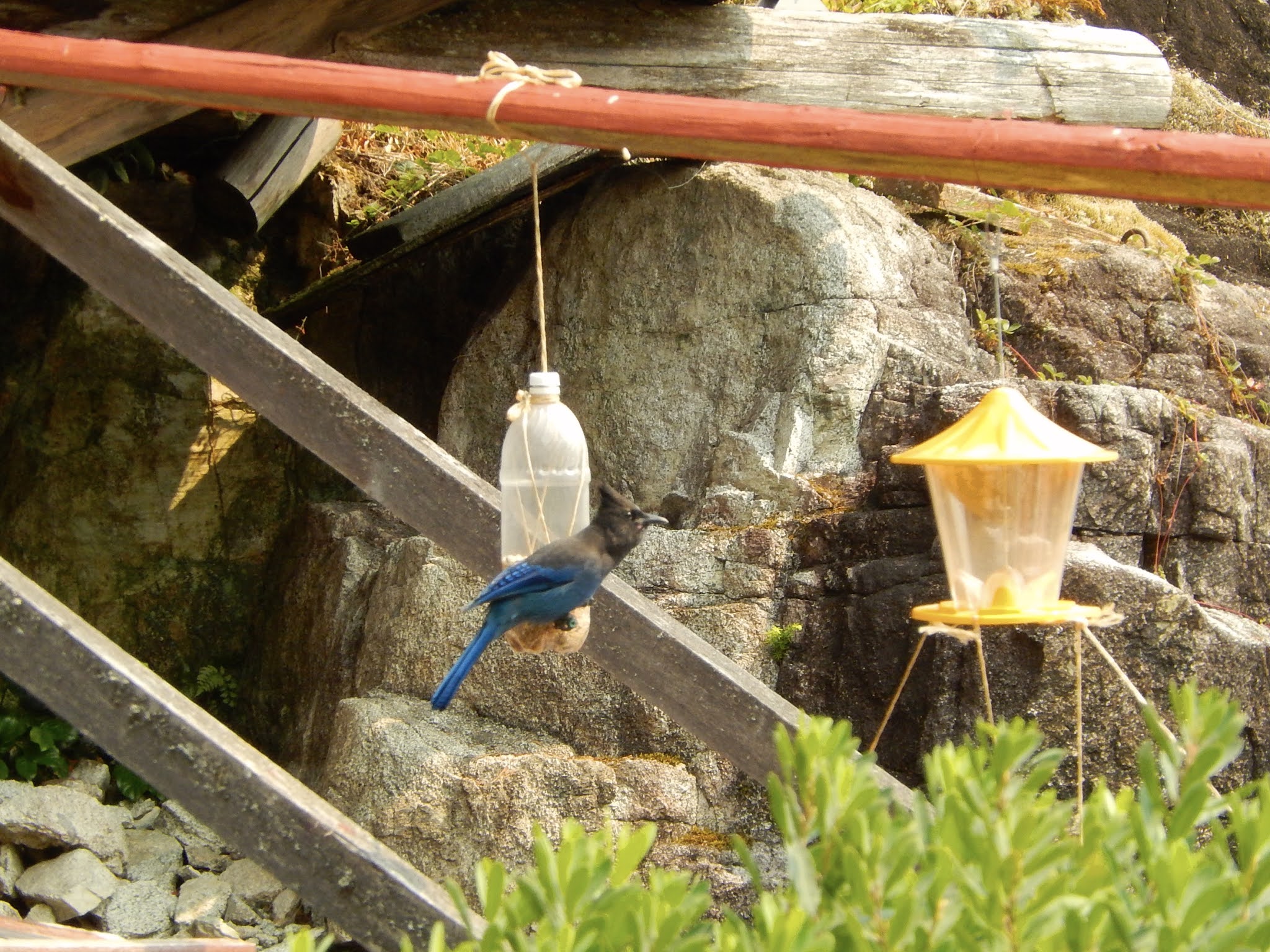
 
Swinging on the feeder.
This week I heard a familiar cry from the granite cliff next to our float cabin home. It was a Steller's Jay. I discovered their presence in our area in 2017 when one arrived to enjoy some seed at my homemade twirling bird feeder. If one wasn't annoying enough, in 2018 five arrived at once.


Last year I didn't see any before we left for a fall RV trip to Arizona. This year were are staying longer up the lake due to the COVID situation. Yesterday, a single Jay arrived and loudly announced his presence. This morning he played the part of a rooster to wake us up.

 
Steller's Jays are member of the Corvid family including ravens, crows, and magpies. They can be annoying at times, but they are still a welcome visitor to our off-the-grid home. -- Margy 
 
P.S. This is the first post I've written with the new version of Blogger. It has been a horrible experience trying to write and edit. If you use Blogger, what has been your experience? Any tips you have would be greatly appreciated.

Wednesday, July 22, 2020

Coastal BC Birds: Barn Swallows Return

The nest above and plastic below.
When we arrived home at the float cabin, we were pleased to see a pair of Barn Swallows had returned this year to build a nest.

We weren't totally happy with the location outside our front door and under the porch roof, but we didn't want to disturb the the breeding pair and their recent hatchlings.

To make cleanup easier, I put plastic on the deck under the nest. Since it's right next to our picnic table, I wash it off a few times each day.

Three chicks are growing quickly.
The parents are used to our presence, so we can still eat outdoors and sit in the shade of our porch.

Last year's attempt had a disastrous end. After a week of building, the nest fell and the pair disappeared. I don't know if this is the same pair, but I hope so.

Barn Swallows build mud nests in some locations, but here it's a mixture of mud and grass.

A precarious spot for next building.

It seems they pick the most precarious spots to build their nests. This one has only a one and three-quarter inch lower support. At least the area is wide and has a substantial support on one side.

Mom and Dad both feed the chicks from dawn to dusk.

Somehow Barn Swallows are able to concoct a substance sticky enough to hold everything together, most of the time. Unfortunately, we've had a few fall over the years.

Sitting on the nest to protect the growing chicks.

Squirrels are known to attack swallow nests. A gray squirrel tried to do this week. One parent sat on the nest to protect the babies. The other chased the squirrel away until I got out the door to give him a hand.

A high flying swallow.
Based on the size of the chicks, we guess they hatched just before we arrived on July 15. One featherless baby fell out of the nest the next day. Now there are three hungry kids driving both of their parents ragged all day long bringing a steady stream of bugs.

We enjoy watching them grow and someday soon they will take to the skies like their acrobatic parents. -- Margy

Thursday, April 23, 2020

#ThrowbackThursday: Spring Birds

This week while Wayne and I are sheltering in place in Bellingham, Washington, I'm sharing some of the birds that I would normally be welcoming to our float cabin home on Powell Lake in Coastal BC. I may not be there this spring, but I'm sure they are.

Follow the links below to learn more about each one.

One of the first to arrive in spring is the American Robin. The weather may still be cold, rainy and cloudy, but they foretell the longer days, warmer weather and blooming flowers to come.

An American Robin sitting on driftwood at the float cabin.

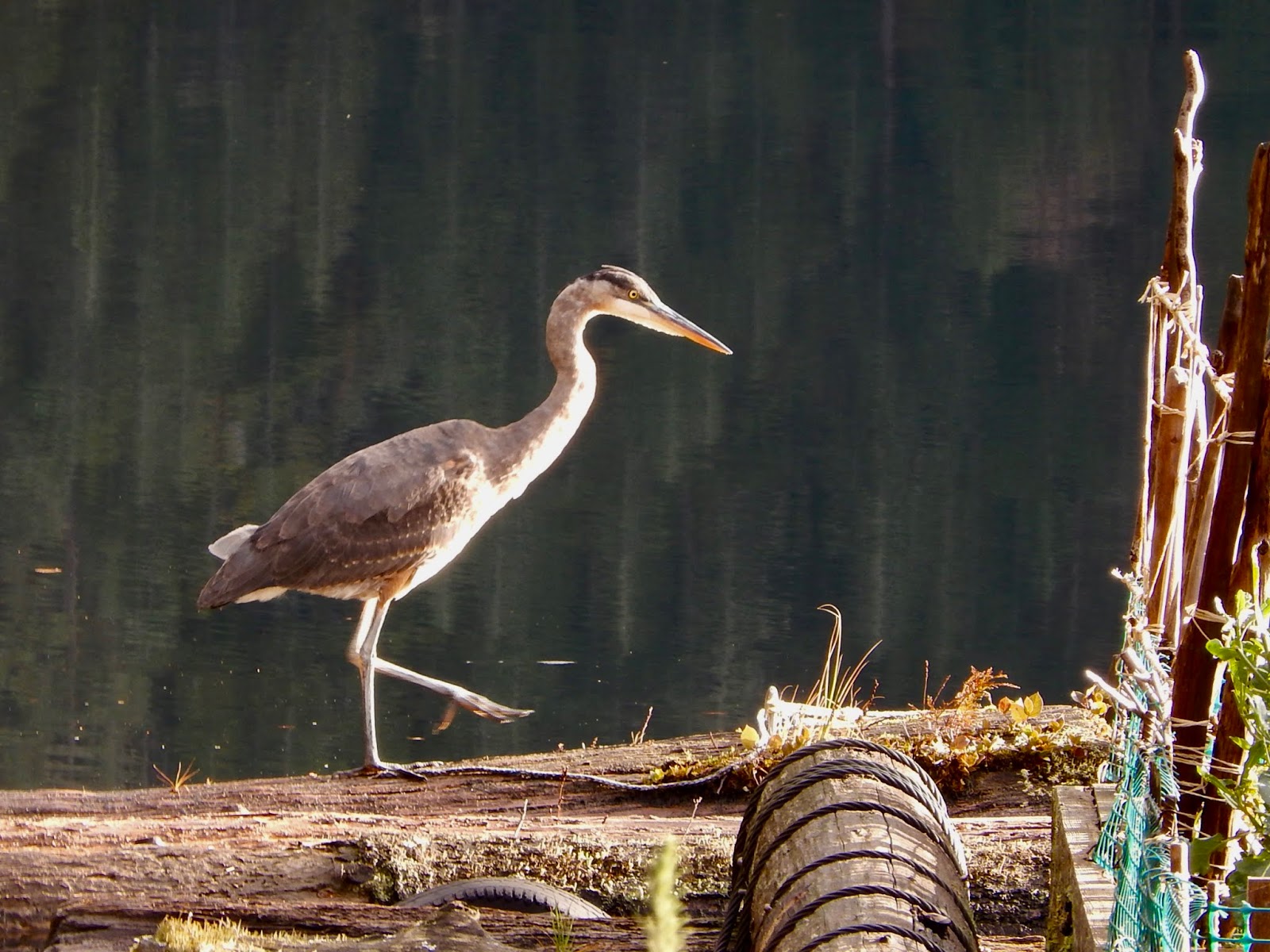
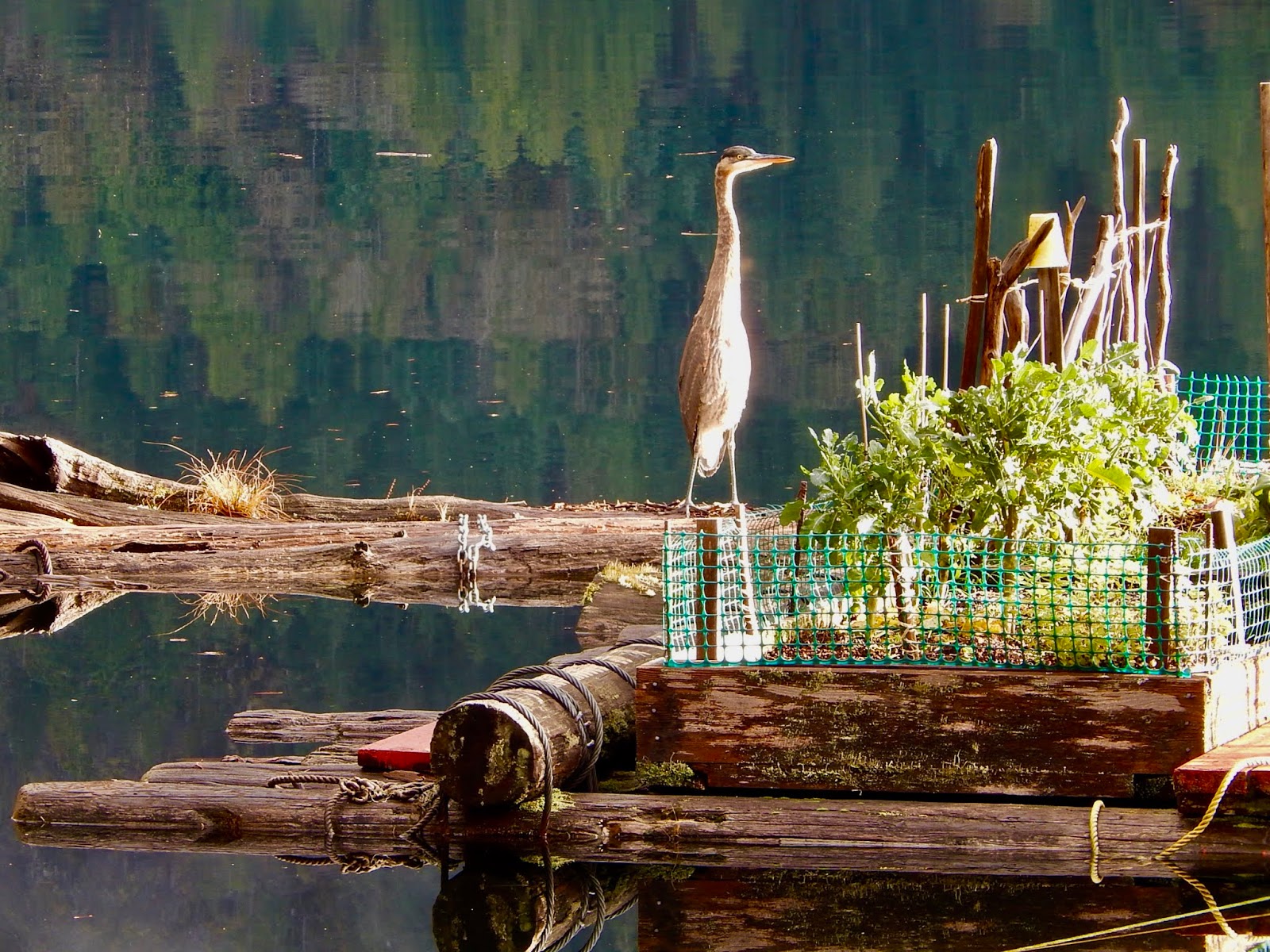
One of the most unusual birds that comes to visit our float cabin is the Great Blue Heron. They are frequently seen in town, especially at the marina, but each year one will come for an extended visit to our log boom to fish. They have such a distinctive prehistoric cry.

A Great Blue Heron visits our log boom to fish for his dinner.

Once we had an unwelcome spring visitor, an American Flicker. It wasn't the American part that made her unwelcome. It was her desire to drill a hole in our wall to build a nest. We chased her away, blocked the hole she started under the eaves and put up "scary" things to deter her return. It worked, but we still have a spot as a reminder.

An American Flicker tried to nest in our cabin wall.

It wouldn't be Canada without Canada Geese. They come to Hole in the Wall where there are shallow beaches to raise their families. Later they bring their goslings by the cabin and try to sneak vegetables from my float garden.

Geese pair for life and arrive in early spring to prepare for nesting.

In 2010, Red Throated Loons arrived at Hole in the Wall. They took over territory from the Common Loons that previously came to visit. They are beautiful birds and when they come into our "front yard" you can hear them coo lovingly to each other. Here a short video.


Towards the end of spring, the Barn Swallows arrive. One pair usually builds a nest under the eaves over our front porch. In the beginning, nests would fall from the narrow ledge. Wayne and I stepped in to install a platform and added a padded cushion below in case any babies fell from their lofty perch.

Mother Barn Swallow sitting on her eggs under the eaves.

I will miss welcoming these annual visitors back home. Hopefully, they'll still be there to welcome me back by early summer at the latest.

Which birds do you like to welcome back each spring to your home? -- Margy

Friday, July 26, 2019

Cabin Journal: Beds, Bugs and Birds

Carrots are gone and the beds are ready for planting.
Float cabin living has lots of outdoor activities. Garden beds need to be cleaned out and replanted. Bugs (and all sorts of insects) come out. Birds return to nest.

June 4, 2019

Before we unloaded the boat after a trip to the States, we did a quick walk around the cabin deck. I could tell from a distance that the carrots in the floating garden had gone to seed in our absence and had three foot stems with white flowers on top. They wouldn't be good to eat, but were pretty in their own way. My garlic was about a foot tall and volunteer arugula was flowering bright yellow. There wasn't time to attend to gardening chores that night, everything could wait one more day.


June 4, 2019

The next thing I noticed was a Yellow Jacket paper nest beginning under the eaves near the kitchen window. That would need immediate attention after dark when they are at rest. I checked another favourite nesting spot under the overhang on Gemini's windshield. Sure enough, another nest. We got home just in the nick of time for both. Wayne shot them with wasp spray then knocked the nests into the water for good measure!


June 6, 2019

Barn swallows come to nest every year. We enjoy their company, but when they try to nest under the front porch we have to shoo them away. We've tried several ways to deter them. This year I swept down the nest beginnings and put a broom in its place. I had to keep sweeping and moving brooms until the swallows took the hint and found a better spot.


Coming home is always exciting, especially because we never know what we might find. -- Margy

Sunday, June 30, 2019

Summer Cabin Visitors

Winter is very quite up the lake at our float cabin home. By late spring, birds and critters start to return. Then as summer starts to settle in, so do they. They come to eat from the abundance in our forest and to raise their young to start a new generation. Two of my favourite visitors are the chipmunks and Oregon Juncos.

An Oregon Junco eating seeds on the bridge to shore

The chipmunks and Oregon Juncos have a symbiotic relationship. The birds flick seeds from my feeders that they don't like down onto our bridge to shore or into the lake.

One of the two resident chipmunks enjoying a snack.

The chipmunks (there's a pair) feast on the fallen seeds in two ways. The easiest is to eat the ones that land on the bridge. They also run along the breakwater logs floating nearby to scoop up the tasty treats that cling at the water's edge. They are so much fun to watch.


Do you have any special animals around your home? Which are your favourites? -- Margy

Saturday, January 12, 2019

Coastal BC Birds: Great Blue Heron

We have a seasonal visitor to our float cabin home on Powell Lake, a Great Blue Heron. Each fall he (or she maybe) returns to our protective log booms to fish. He stands motionless for a long time before leaping into action to catch a meal.

One morning I went out front and saw the Heron standing on the boom.

Look to the left of my floating garden for the Heron.

I watched for a long time and even walked out to the corner of the float to take pictures without disturbing him.

Changing position.

Great Blue Herons are a common sight at the marina in town and nest in nearby trees. The subspecies in our area is the Pacific Great Blue Heron (Ardea herodias fannini).

Flexing his wings.

The Pacific Great Blue Heron has Canadian Species at Risk Act (SARA) and Canadian Committee on the Status of Endangered Wildlife in Canada (COSEWIC) special concern status. They are protected under the British Columbia Wildlife Act and the Canadian Migratory Birds Convention. When the City of Powell River was building a new community track, construction stopped due to the discovery of nests. We now have a lovely track away from the nesting site.

Framed by my floating garden.

Pacific Great Blue Herons are found from Alaska to Washington State in coastal areas. They are a large bird standing over a metre in height. There are 4,000-5,000 adults in Canada.

Alert!
Herons are identified by their blue and grey feathers and black stripe from the eyes backward. In flight, Herons look prehistoric, matched by its piercing squawk.

Do you have Herons where you live? Are you as infatuated with them as I am? -- Margy

References: Nature Canada, Pacific Great Blue Heron (online), The Cornell Lab of Ornithology All About Birds, Great Blue Heron (online), and Bird Watcher's Digest, Great Blue Heron (online).

Monday, March 19, 2018

Coastal BC Birds: Oregon Junco

Oregon Junco

One bird that arrives in spring at our float cabin on Powell Lake is the Oregon Junco, a regional variation of the Dark-eyed Junco.  They are a member of the sparrow family with a distinctive dark hooded head and brownish bodies. A sturdy beak is well suited for seed eating.

An Oregon Junco on our granite cliff.

Oregon Juncos are common in the western United States and British Columbia. They live in the understory of coniferous forests. In winter they move to open areas including fields and lawns in town.

An Oregon Junco fledgling on our bridge to shore.

Oregon Juncos typically have two broods a year. Juncos build ground-based nests in protected areas. Each brood has from three to five chicks that hatch in about twelve days and fledge about twelve days later.

Mother Junco feeds one of her fledglings a seed.

For the last two years, a pair of Juncos has raised their family on our granite cliff. The female brought her young chicks to the seed feeders on our bridge to shore. It was also fun to watch young birds playing in the water in the shallows nearby.

Two fledglings taking a bath in the shallows on shore.

One year a large flock of Oregon Juncos arrived at the same time. It was the same week that I planted seeds in my float garden.

Wayne with our protective garden netting.
Wayne and I raced to cover the beds with bird netting to protect my crops. Even so, some got through and we had to help them get out. After the fact we termed this the Junco Wars. You can read that story by clicking here. -- Margy

Saturday, November 04, 2017

Coastal BC Bird: Song Sparrow

 Song Sparrow Antics

Several years ago I purchased a Bushnell Trophy Cam. You can read about it here. I've been very happy with it. Rather than getting a critter cam to hunt wild game, I use it to discover who's hanging around the deck of our float cabin home.
Usually I set it up during woodrat (packrat) season. When I suspect one is in the vicinity, I use the camera to make sure before asking Wayne to set up our Havahart live trap. While I don't like disturbing wildlife, I need to protect my garden plants. Trapping and relocating critters is a compromise.

This week when I found dirt on the cabin deck around one of my empty pots, I decided to use my camera to determine what was going on.


I discovered the Song Sparrow that arrived this week was the culprit. He was looking for seeds in the soil, and flicking dirt out onto the deck in the process.

It's hard to get mad at this little guy. With all of our summer birds gone, it's nice to have one around to keep us company. Do you have any winter birds to brighten your days? -- Margy

Saturday, October 14, 2017

How to Improve a Twirling Bottle Bird Feeder

My twirling bird feeder in summer.
A little over a year ago, I saved directions about how to make a twirling bottle bird feeder from one of my favourite blogs, Wanderin' Weeta (With Waterfowl and Weeds).

I made one of my own last summer. Click here to see the directions. It worked fine until the rains came. The u-shaped openings that allow birds to feed also allowed rain water to get into the bottom with no way out. The result, soaked and swollen birdseed.


Using a nail to drill holes in the bottom.
It was time to make some modifications or take it down until next summer.

I chose to make some changes to improve performance.

Improvements for the Twirling Bottle Bird Feeder:
Cut a small hole in the pan's middle.
Tape the edges to prevent leakage.
  • Drill small holes in the bottom to allow rainwater to drain.
  • Use a small metal pie pan for a roof. 
  • Add plastic beads to the bottom to reduce the amount of seed near the drain holes.
  • Use a fuel funnel to fill the bottle through the small top opening.
  • Screw the cap back on above the new roof.
  • Hang the bird feeder from a tree or post. 
  • To keep squirrels off, hang it at least a foot away from any branch. 
Insert plastic beads to fill the bottom area.
I hung my new and improved twirling bird feeder back on the bridge railing.

It is in a perfect spot for me to watch the action from my side of the sofa in the cabin.

So far, two Oregon Juncos have been using it.

Beads fill area below the feeder openings.
Plus a chipmunk who's learned how to leap about two feet from the bridge deck up onto the smooth round perch.

At least he eats daintily and doesn't flick the seeds into the lake water below.

Using a fuel funnel to fill with seeds.
Now I use a plastic fuel funnel to fill my bottle.

The bottom of the funnel fits nicely into the top opening. No more seeds spilling out of my rolled up paper funnel.

Did it solve my problem? So far, but the really heavy rains haven't arrived yet. I'll keep you posted.

The improved twirling bottle bird feeder hanging from our bridge to shore.

Here's my feeder ready for whatever the fall and winter may bring, or at least I hope so.

Thanks again to Wanderin' Weeta for this great idea. And for my readers, I highly recommend visiting her blog. She's a nature expert, superb photographer and takes us along to explore Vancouver Island's many trails and back roads. -- Margy

Monday, August 07, 2017

How to Make a Twirling Bottle Bird Feeder

A little over a year ago I saved directions about how to make a twirling bottle bird feeder from one of my favourite blogs, Wanderin' Weeta (With Waterfowl and Weeds).

The twirling design was to make it squirrel proof. My problem isn't squirrels, but a Steller's Jay that is making a mess with my bird feeders. He's too big and knocks the seeds into the lake.

Here are the directions from Wanderin' Weeta's site, slightly modified:

Materials:

  • Empty plastic pop bottle with screw-top lid
  • Clean thin twig about 8 inches long
  • Sturdy twine
  • A washer or nut
  • Duct tape
Tools:
  • Sharp knife
  • Hammer 
  • Small nail, large nail and a straight pen
Directions:
  • Choose a clean plastic pop bottle.
  • Remove the label.
  • Push a small nail through the plastic about an inch and a half up from the bottom. Use a large nail then a straight pen to make the hole fit the stick.
  • Make another hole on the opposite side of the bottle.
  • Use a nail and hammer to make a hole in the center of the lid.
  • Use a sharp knife to cut two inch horizontal slits about 1/2 inch above each hole. 
  • I used duct tape to cover the sharp lower slit edges.
  • Squeeze just above the slits to make U-shaped openings for birds to reach the seeds. 
  • Thread twine through the slits. Tie one end firmly around the top of the bottle just below the lid. Pull on the other end until the twine holds the two U-shaped sections permanently open. Tie firmly around the neck of the bottle. 
  • Force the twig (I used a length of bamboo plant stake) through the bottle. It should fit snugly. This will make the perches.
  • Thread another length of twine, about 3 feet long, through the lid. Tie the inside end around the washer or nut. Pull the washer tight inside the lid and tie a knot on the outside. 
Finishing Touches:
  • Fill your bottle with bird seed. 
  • Screw on the cap.
  • Hang the bird feeder from a tree or post. To keep squirrels off, hang it at least a foot away from any branch. 
I hung my new twirling bird feeder on the bridge railing.


Did it solve my Steller's Jay problem? Well, not completely. But with smaller holes in the feeder, the Oregon Juncos at least have a fighting chance to get something to eat before it all gets flicked out.


Thanks Wanderin' Weeta for giving me this great idea. And for my readers, I highly recommend visiting her website. She's a nature expert, superb photographer and takes us along to explore Vancouver Island's many trails and back roads. -- Margy

Saturday, May 27, 2017

Coastal BC Birds: Brown-headed Cowbird

Brown-headed Cowbird

A Brown-headed Catbird at the feeder.
On a sunny spring day we had a Brown-headed Cowbird visit our birdseed feeder at the cabin on Powell Lake. This is the second time I've seen one in the Powell River region. The first was on a quad ride to Fiddlehead Farm back in 2008.

Cowbirds are a highly mobile species. After following herds of animals on the prairies for eons, they've developed the practice of laying eggs in other birds' nests. Without the requirement to incubate eggs and nurture young, they can focus on foraging and aren't tied down to a specific location. Point taken. I haven't seen the Cowbird return.


Brown-headed Cowbirds are in the blackbird family. Mine was a lone male with a glossy black body and dark brown head. Females have a brownish body with lighter areas on the head and underside.

Females lay their eggs in a wide variety of other birds' nests. Some can detect the "parasitic" egg but others cannot. Because Cowbird eggs hatch quicker and produce larger chicks, they are more adept at surviving than the host bird's hatchlings.


Brown-headed Cowbirds are common throughout North America. They are annual residents along the west coast up to British Columbia and move in the summer to more northern breeding areas in the western US and across the southern Canadian provinces. -- Margy

Reference: All About Birds: The Cornell Lab of Ornithology (online).

Saturday, April 22, 2017

Coastal BC Birds: Talk to Me Goose

Canada Geese

After a long quiet winter, it's nice to have birds returning to Hole in the Wall on Powell Lake.

The first to arrive on the scene were the Canada Geese. A flight of five came honking their way into Hole in the Wall early in April.


Since then, the group has split up. Three have been congregating at the back of the Hole, and two have taken up residency in John's back bay across from us.


We can hear them honking back and forth early in the morning. Usually they stay out in the lake, but recently a pair has been coming up to stand on our log booms and swim in our inner pool area.


I've been keeping a eye on them because I don't want troubles out at my floating garden. In the past, geese have climbed aboard to partake of my tender crops. But so far, so good.


I had to play a little joke on the male goose. Top Gun is one of our favourite movies (after all, we're pilots). One memorable line was, "Talk to me Goose." Goose was the call sign of pilot Maverick's EWO (electronics warfare officer).


We enjoy watching all of the birds and animals that visit our float cabin home. What critters have returned to your area already? -- Margy