Showing posts with label Plants. Show all posts

Saturday, September 26, 2020

Come to Powell Lake for Fall Foliage

Leaves turning on Goat Island.
People go east on expensive fall foliage trips. It's a region well known for trees in spectacular hues of yellow, orange, red, purple and brown. Like the Atlantic Provinces, broadleaf trees around Powell Lake change colour.

In front of our cabin, Goat Island has a glorious display of maples, dogwoods and alders. The swaths of colour paint the hillsides along stream carved gullies and slopes.


Have you wondered how this colourful display occurs? Chlorophyll, the pigment that gives leaves their green colour, gets energy from sunlight to transform carbon dioxide and water into carbohydrates (sugars and starch). Leaves also have yellow to orange pigments called carotene and xanthophyll, but they are overpowered by chlorophyll most of the year. When fall arrives, things change.

Days are shorter and deciduous trees, ones that lose their leaves, get ready for winter. Chlorophyll, and its green colour, begins to diminish. This allows the yellow and orange colours to become more dominant.

Reds and purples are created when glucose (sugars) are trapped in leaves after photosynthesis stops. Bright sunny days and cool nights in autumn cause leaves to turn the glucose into red to purple colours. A brown colour is from wastes left behind in the leaves.


As winter approaches, leaves begin to fall. Where the stem of a leaf is attached to the tree there is a special layer of cells. This layer gradually breaks down until it can no longer support the weight of the leaf. When storm winds blow, leaves drop. Trees become dormant and live off the food they have stored over the summer. Their stems, twigs and buds are equipped to survive extreme cold until the following spring.


Fallen leaves are not wasted. They become part of the thick humus layer of the forest floor and decay to replenish the soil with nutrients. There also absorb rainfall, hold moisture and become food for organisms that are important to the forest ecosystem.


Here are some resources if you would like more details:

Next year when travel is safer, come to Powell River in Coastal BC to experience fall foliage. People here are friendly, the resorts are uncrowded and the restaurants are great. The opportunities are limitless. You won’t be sorry you chose to head north rather than east. -- Margy

Wednesday, September 04, 2019

Coastal BC Plants: Indian Pipe

Indian Pipe

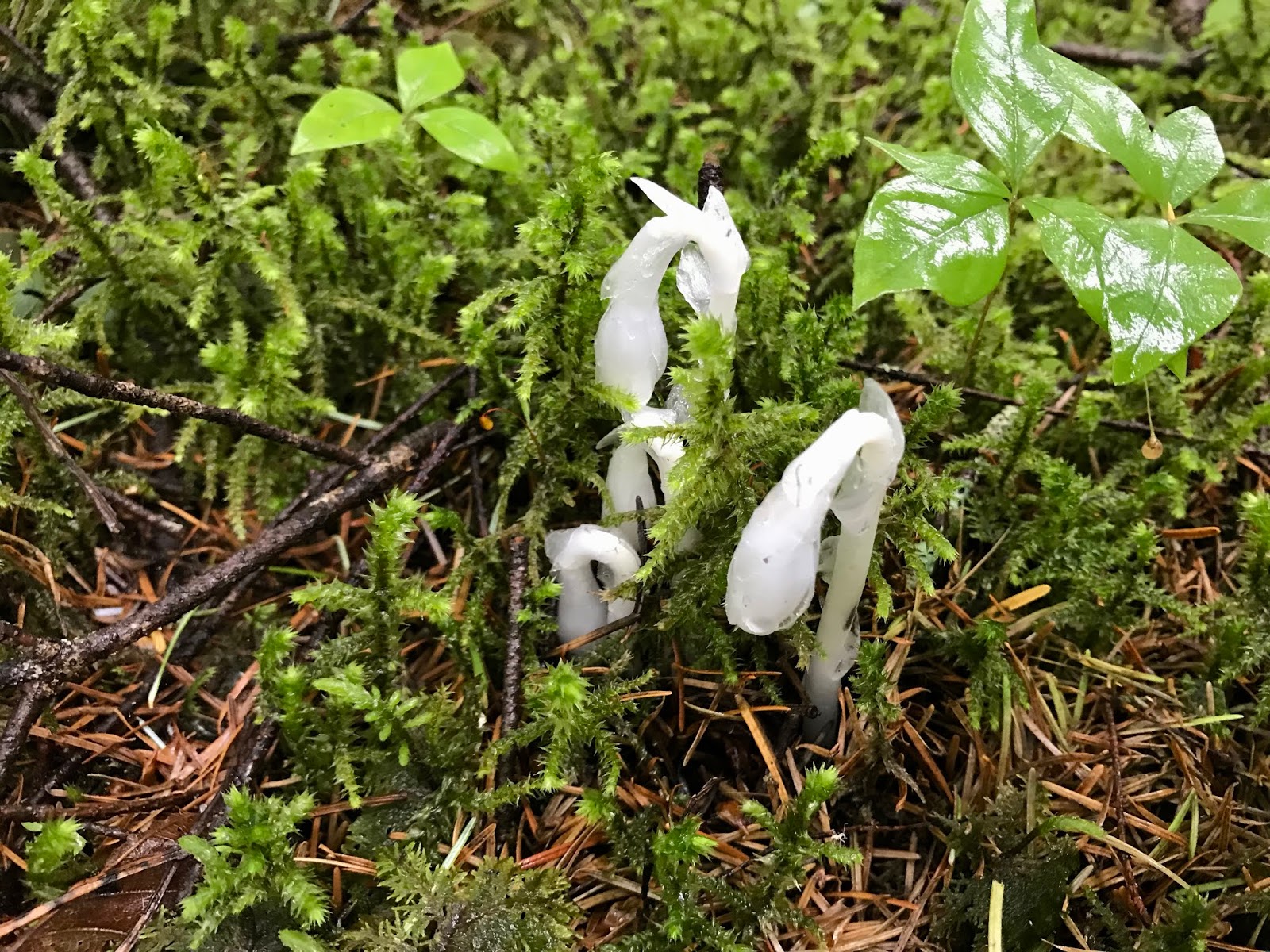
Indian Pipe poking up through the moist duff.
I was walking through a grove of mature hemlocks and firs when a spot of white caught my eye. What I thought was debris on the ground turned out to be an exciting find, Indian Pipe (Monotropa uniflora) emerging after days of rain with warm temperatures.

These pictures were taken on July 11. We were supposed to have a dry, hot summer, but unexpected rain changed growing conditions, especially in the shaded forest understory.

These specimens were just emerging, so they were a brilliant white. At maturity, they turn dark or black. Another common name is Ghost Plant, you can see why.


Indian Pipe is a herbaceous (non-woody) perennial (lives from year to year) plant. It's white because there is no chlorophyll. Nourishment comes from underground fungi associated with tree roots. You can find Indian Pipe in temperate, moist zones of Asia and North America.


They appear after dry spells followed by periods of rain. The white stems, rise from a fleshy root mass. The plants reach their full height (5–30 centimetres) in just a few days. Small leaf-like structures are translucent, giving them their ghostly appearance. At the top there is a single flower that droops downward, looking like an upside-down pipe, until the fruiting body is mature.


Have you ever discovered an unusual plant? What was it? Where did you find it? -- Margy

References: E-Flora BC Atlas: Monotropa uniflora and Wikipedia: Monotropa uniflora.

Friday, March 23, 2018

Coastal BC Plants: Salmonberry

Salmonberry

Salmonberry buds ready to burst forth.
There are signs everywhere when spring arrives. On a quad ride we found beautiful bright pink (sometimes purple) salmonberry flowers just starting to open.

Soon they will bloom and the green leaves will emerge. Later they will have ripe orange-red berries to nourish humans and animals alike.

A lone salmonberry bush next to a creek.
Salmonberry plants (Rubus spectabilis) make a rambling bush up to four feet tall. They can make a huge wall of brambles if the conditions are right. This one on a rock riverbank is a standalone. They have small thorns, especially towards the bottom of the branches.


A ripening salmonberry.
The sawtooth edged leaves come in sets of three. The fruits come in yellow, salmon and dark red raspberry-like berries. You will find them in coastal regions from California to Alaska. First Nation people used the roots, leaves and berries for medicinal purposes and as a food source.

The berries are juicy, but sometimes bland in flavour. But that doesn't matter to the forest dwellers.

A ripe Salmonberry ready for eating.

As an early flowering and fruiting plant, it's a favourite with birds and animals. Hummingbirds are attracted to the brilliant flowers, small animals enjoy the tender leaves, and of course the bears love the ripe fruit after a long winter's nap.

I remember picking and eating Salmonberries as a child on camping trips with my parents. Those would have been California Salmonberries. Now I get to enjoy their British Columbian relatives. Do you have any fond Salmonberry memories? -- Margy

Wednesday, October 11, 2017

Coastal BC Plants: Pacific Ninebark

Pacific Ninebark

During early summer, Wayne and I went on a camping trip to Vancouver Island to go quad riding on the logging roads and trails northwest of Campbell River. While we were riding north of McCreight Lake, we found an old logging road heading off into the bush.

We followed it for about a klick and came out into a meadow filled with Sweet Gale.

A creek ran through the meadow and nearby I found a large shrub covered with clusters of white flowers. From a distance it blended into the trees bordering the meadow.

A large Pacific Ninebark shrub in the middle of the forefront.

Pacific Ninebark (Physocarpus capitatus) is a member of the rose (Rosaceae) family. It grows to 4 metres (13 feet) in height. The leaves are palmate, deeply veined, serated on the edges, and have 3 to 5 lobes. They are a shiny green and lush looking.


The flowers form in clusters.  Each has five round white petals with yellow pistils and 30 stamens with long filaments.


Some of the clusters flowers changing into red seeds pods.


Here's a branch that contains both flowers and seeds.

Flowers and seeds are present in early summer.

When you take an old road into the bush, you never know what you may find. What kinds of things have you discovered? -- Margy

Reference: E-Flora BC: Electronic Atlas of the Flora of British Columbia (online) and "Plant Parts" at The Great Plant Escape (online).

Wednesday, September 27, 2017

Coastal BC Plants: Arctic Lupine

Arctic Lupine

An Arctic Lupine growing on the rocky shore.
We went on a summer camping trip to the head of Goat Lake. We beached our barge to offload quads and camp on the empty deck.

The next morning we rode north on Goat Main. Not far past the barge ramp there's a spur down to the Eldred River.

During winter and spring runoff the river runs high and fast. In summer it recedes to reveal extensive gravel bars. That's where I found an Arctic Lupine amid the stones.


The Arctic Lupine (Lupinus arcticus) is found in meadows, clearings, roadsides and open forests from Alaska to Oregon. It's a perennial herb from the pea family (Fabaceae). On this gravel bar it's hard to imagine it lasting through floods, but the roots must be very hardy.


The leaves are mostly at the base, but also grow along the short stems. The shape is palmate with 6 to 10 leaflets. The cup shape allows them to capture and hold raindrops, and in this case dew from the night before. This lupine is located in close proximity to the river, but in its rocky location doesn't get much moisture during dry summer months.


The flowers are on taller stalks and are most commonly blue. More rare is whitish-pink.


The seeds are a giveaway that it's in the pea family. The pods are 2-4 cm long and covered with fine hairs. Inside there are from 5 to 8 seeds. I was lucky to find this plant with lush foliage, flowers in bloom and seed pods all at the same time.  -- Margy

Reference: E-Flora BC: Electronic Atlas of the Flora of British Columbia (online).

Thursday, September 07, 2017

Canning: Salal Berry Jam

Salal leaves are used by florists and the berries can be eaten.
The granite cliff next to our float cabin gives way to forest. In the shade of firs, hemlocks and cedars a green-leafed shrub called Salal thrives.

I've tasted the berries before. They are somewhat dry and bland, but I've heard they can be made into jam. This year I decided to try.

The berries ripen in early August and look somewhat like a blueberries. I picked enough to make one jar of jam just in case it wasn't to my liking.

Here's the recipe I used to make my jam without pectin.

Salal Berry Jam

Ingredients:

Separating and cleaning berries.
1 cup salal berries
1 cup sugar
1 tablespoon lemon juice

Directions:

Mashing half of the firm berries.
Picking salal berries is sticky work. I found it easiest to pick the whole bunch at the branch tips and separate and clean them at home in water.

Combine all ingredients and heat.
Mash half of the berries to release the juice.

Combine all of the ingredients in a pot that is wide at the bottom and large enough for the sugary mixture to bubble up without running over.

Fill leaving 1/4" headspace.
Cook until the mixture reaches 220 degrees on a candy thermometre.  To ensure the jam has reached the jell point you can test it in several ways. I used the plate method. Drop a teaspoon of jam onto a cold plate and let it sit for 30 seconds. Tilt the plate. If it moves slowly, it's ready.

If you want to make your jam shelf stable for storage, use the water canning method. Here's a link to full instructions at the Ball/Kerr website. 

Fill the jar leaving 1/4" headspace. Wipe the rim and cover with a two-piece lid and ring.

Process the jar in a boiling water canner for 10 minutes. Start timing after the water reaches a full boil. Adjust the time for your altitude if needed. I have a one jar canner that's perfect for small batches.

Small canner for up to one pint.

Turn the heat off and remove the canner lid. Let the jar rest for 5-10 minutes. Use tongs to remove and let the jar cool naturally. Listen for the pinging sound to let you know the jar has sealed.


After 24 hours, check the lid to make sure it doesn't flex up and down when pressed in the center. If it does the jar didn't seal and the jam needs to be refrigerated for immediate use. If the seal is tight, remove the ring and wash the jar before storing in a cool, dark place.

The consistency is perfect for jam. The flavour is strong but not unpleasant. It was plenty sweet, but next time I would use more lemon juice to counteract the bland berries.

Do you preserve foraged foods? What are some of your favourite recipes? -- Margy

Wednesday, May 31, 2017

Coastal BC Plants: Chickweed Monkeyflower

Chickweed Monkeyflower

Tiny Chickweed Monkeyflowers
I was walking up the stairs to my hillside potato patch and saw a few small yellow flowers along the cliff among the moss. I took several pictures and went to my nature guides to make an identification. It turned out to be Chickweed Monkeyflower (Mimulus alsinoides).

This tiny Monkeyflower is a member of the figwort family. One guide calls it a snapdragon, and that’s what it looked like to me. It’s an annual plant, but I don’t remember seeing it before. That could be because it blooms briefly in April (things are a bit late this year due to an extended winter) and because the flowers are only 8-14 mm (1/3 to 1/2 inches) long and the plant itself about 10 cm tall (4 inches).


The flowers stand out because they are bright yellow with a reddish-brown spot on the lower petal. They rise on a slender stalk with small egg-shaped light green leaves.

Chickweed Monkeyflowers grow on moist, shady moss covered cliffs and rocky slopes at lower elevations. Mine was on a granite cliff near the lake surface at an elevation of 155 feet.


Plants use flowers to attract pollinators such as bees. They also attract the attention of passing humans who take the time to go slow and look around. -- Margy

References: Plants and Animals of the Pacific Northwest by Eugene N. Kozloff (Greystone Books, 1995), Trees Shrubs and Flowers to know in British Columbia by C.P. Lyons (J. M. Dent and Sons (Canada) Limited, 1974), and Plants of Coastal British Columbia by Jim Pojar and Andy MacKinnon (Lone Pine Publishing, 1994).

Wednesday, May 17, 2017

Coastal BC Plants: Alaskan Saxifrage

Alaskan Saxifrage

Alaskan Saxifrage among the moss.
I have to walk up four flights of stairs to get up to my hillside potato patch and compost bin. I make the trek several times a week and always look at things along the path. The granite cliff itself is always interesting. And I like to see what the natural vegetation is doing.

On a trip up the stairs I saw some pretty little white flowers. After depositing my vegetable scraps in the bin, I went back to the cabin to get my camera. I used the pictures and my nature guides to find a match. With limited Internet access, books are a great alternative.


Paging through Plants of Coastal British Columbia I found that it was Alaska Saxifrage (Saxafraga ferruginea). This plant is quite widespread and there are several variations along its coastal range from southern Washington to southern Alaska, and from sea level to alpine regions. As a perennial plant, it gets an early start in spring.

Thin reddish stems rise from a cluster of basal leaves.

The plant’s fleshy, hairy, spoon-shaped leaves are arranged in an array around the base. A short (10-35 cm) stiff stem rises straight up, sometimes branching, ending with small white (to purple) five-petaled flowers. The stamens on short stalks in the center give the flowers a spiky appearance. Its nickname is Rusty Saxifrage because of the rust colour in the sepals.


Alaskan Saxifrage can be found on moist cliffs, wet rocks, and mossy spots. Mine were tucked in among the mosses that line the notch up our granite cliff. We are at an elevation of 155 feet. -- Margy

References: Plants of Coastal British Columbia by Jim Pojar and Andy MacKinnon (Lone Pine Publishing, 1994) and E-Flora BC: Electronic Atlas of the Flora of British Columbia (online).

Tuesday, August 23, 2016

Coastal BC Plants: Swamp Gooseberry

Swamp Gooseberry

Gooseberries can be distinguished from Currants because they have prickles and spines on their stems. Otherwise, they are members of the same family. The Swamp Gooseberry is very common along streams, lakes, swamps, and moist forest slopes. We found this example next to Bob’s Lake on Texada Island growing in the shade of a fir tree.


Swamp Gooseberries grow at low elevations from northern California to southern Vancouver Island. The plants are from three to five feet tall and have reddish flowers in June. The glossy green leaves are small and maple-shaped with five indented lobes. Dark red or purple berries form in late summer. The berries are edible but don’t have the most pleasant flavour raw, but it is said that their juice can be made into wine.


Caution should be taken because the spines can cause an allergic reaction in some individuals. -- Margy

References: Wild Berries of the Pacific Northwest by J.E. (Ted) Underhill (Hancock House, 1974), and Plants of Coastal British Columbia by Jim Pojar and Andy MacKinnon (Lone Pine, 1994).

Tuesday, August 02, 2016

Coastal BC Plants: Oxeye Daisy

Oxeye Daisy

When Wayne and I went quad riding on Texada Island this July, everywhere we looked there were carpets of daisies bobbing their pretty white and yellow heads.

Oxeye Daisies growing in profusion in a road cut.

The variety was Oxeye Daisies (Chrysanthemum leucanthemum). They are a member of the Chrysanthemum family and were introduced to the area as a weed from Europe. Since they have spread far and wide.


The Oxeye Daisy is a perennial plant that regenerates annually from a woody rhizome. They grow profusely in fields, meadows, roadsides, and clearings such as logging cuts at lower elevations. Leaves are found predominately at the base of the plant with a straight stalk supporting each flower head.


The young leaves are edible and very sweet, and the flowers can be used to make a wine similar to dandelion wine. These daisies may be weeds, but very beautiful ones in summer. Well I guess that is unless they aren’t taking over your hay field or pasture. -- Margy

References: Roadside Wildflowers of the Northwest by J.E. (Ted) Underhill (Hancock House, 1981), and Plants of Coastal British Columbia by Jim Pojar and Andy MacKinnon (Lone Pine, 1994).

Wednesday, July 20, 2016

Coastal BC Plants: Butterfly Bush

Butterfly Bush

Butterfly Bush (Buddleja davidii) is not a native species to British Columbia. Much like Scotch Broom, it was an ornamental plant loved by gardeners because it attracts butterflies. Because of their numerous blossoms and tremendous numbers of seeds, plants have escaped into the wild and proliferated.


Blooms come in a variety of colours ranging from light (almost pink) to dark purple. You can find Butterfly Bush almost everywhere along the BC coast and inland. It is especially prevalent along dirt roads and logging cut blocks.


While butterflies do benefit from the nectar, Butterfly Bush does not serve as a food source for their offspring in the larval stage.

A bee taking advantage of nectar from  a large Butterfly Bush blossom.

This time of year Butterfly Bush is blooming just about everywhere. It is very evident that it is taking over territory from native species. But like the Scotch Broom, the colourful blooms in late spring and early summer are eye catching. -- Margy