Showing posts with label Woodstove. Show all posts

Wednesday, December 05, 2018

Sharpening the Saw

Elementary principal days.
When I worked for the school district, we talked about "sharpening the saw" in a metaphysical sense. It came from reading and putting into practice the seven habits of highly effective people advocated by Stephen Covey. It was about renewing the four dimensions of our lives, the physical, spiritual, mental and social/emotional states.

Moving to our float cabin on Powell Lake took care of all those dimensions for Wayne and I in one fell swoop.

Our float cabin home at the "wall" in Hole in the wall.

One test in self sufficiency was getting and preparing our own wood for winter. Summer and fall driftwood gathering seasons.

The barge helps gather driftwood.

We prefer pieces that don't require splitting, but sometimes larger logs float up to our cabin and beg to be taken. All of the wood has to be cut to size to fit into our Kozi wood-burning stove.

A driftwood log that floating into our water lease.

An important step was learning about chainsaws. Our good friend and mentor John helped Wayne pick one that would fit our needs, a Stihl, and taught him how to use it. And use it he does. 

Preparing firewood for the floating woodshed.

Wayne does the chainsaw cutting, I help with the splitting. In the beginning we used a stump on our wood storage float. That was work!


After ten years of doing it the hard way, Wayne got me the best present, an electric log splitter that runs on a gas generator. Since I'm the photographer of the family, here's Wayne and John giving it the trial run.  Yes I know, we were so excited we didn't put on our regular safety equipment: boots, gloves, safety glasses and ear defenders.


Finally comes the task I like best, sharpening the saw. John taught me how to do it. Each tooth on the chain has to get uniform attention.  Sharpening the saw has now taken on a whole new meaning.


I know it's right when I can feel the edge just catch the skin of my finger after several strokes with the file. A felt pen mark ensures that I go around the chain one time before reversing the saw and filing the teeth that face in the opposite direction. If I do my job well, the saw cuts through the wood like butter.


One good thing about Wayne and I is that we each like different parts of the same task. When we work together as a team, the result is better than if either of us did it alone.

It may not be what Covey had in mind, but our saw is both physically and metaphysically sharp. How about yours? -- Margy

Tuesday, November 20, 2018

Woodstove Safety

When we first got our float cabin, I was a little afraid of the wood burning stove. It was hard for me to get used to a fire burning in a small metal box in the middle of my living room. I had no prior experience with such a thing in my Los Angeles city-folk life. But when the nights (and days) got cold, we quickly overcame our trepidation and started using our Kozi stove.

Wayne's chimney pipe cleaning tools.
When our friend John built the cabin he installed our stove to minimize fire danger, but it's up to us to keep it that way. We watch the stove's components to make sure they are in good condition and replace any that seem worn or damaged. So far, we've replaced the door gasket twice. Fortunately, stove supplies can be found in most hardware stores, at least here in the north.

Wayne on the porch cleaning out the horizontal wall and exterior chimney pipes.

Cleaning the inside chimney and sealing a joint.
Chimney sweeping is crucial for safe wood stove use. Even with our thermometer to monitor fire conditions, creosote and ash build up in the chimney pipe and on our stove's smoke shelf. On a sunny fall day (at least a non-rainy one) we don't build a fire.

First, Wayne goes up on the porch roof to clean the exterior pipe and chimney cap. Next, we go indoors to disassemble and clean the interior pipe and the stove's smoke shelf.


I'm amazed how much buildup there is in just a few short winter months. But on the other hand, our trusty stove is running almost 24/7 that time of year.

If you have a woodstove, do you have any installation, care or maintenance tips? Any funny, or even scary stories? Let's hear them.

Want to find out more about our float cabin living? Try reading Up the Lake. If you use a Kindle or e-book you can get a copy for free at Amazon or most online booksellers.

For more information about all of the Coastal BC Stories books visit our website at PowellRiverBooks.com. -- Margy

Friday, June 01, 2018

Float Cabin Living: How do you stay warm?

Our Kozi brand woodstove.
If you are following this series, you've already read about our weather and storms.

Wayne and I couldn't live up the lake in all seasons without a way to keep our home warm.

Nights are longer and temperatures cool by late September.  What most people call winter weather begins in earnest by late October. From then until May (sometimes early June) we need heat.


A rare snowy day.
Our solution is old fashioned wood combustion in our Kozi wood-burning stove. It came with our cabin and has served us well.

To burn wood, you have to gather and process wood.


Gathering floating wood.
Floating wood comes right to our doorstep when the lake level rises. We also use our barge to gather wood to cut and stack.

Our friend John built a floating woodshed for us. Wood is very heavy and you don't want it to weight down the cabin's main deck.

Processing wood for the woodshed.
Wayne learned to use a chainsaw to cut log chunks into stove lengths, then we used an ax and sledge hammer to split the larger pieces.

That is until I got an electric log splitter for my birthday.


Diamonds may be a girl's best friend, but off the grid labour saving devices are more appreciated. Below are some links for more information about heating our cabin home.

Woodstove cooking.
Stocking the woodpile.
Chainsaw maintenance.
Rotating chimney cap.
Chimney maintenance. 
Indoor storage shelf.
Woodstove refinishing.
Woodstove cooking.
Woodstove baking.

Come on in, sit by the fire and get Kozi warm.


How do you keep yourself warm and toasty on long winter nights? -- Margy

Monday, November 20, 2017

Stocking Up the Woodpile

Living off the grid has a lot of joys. It lessens our environmental footprint, we have a simple lifestyle, and it challenges us to do things differently. Colder months are coming, and our heat is 100% from wood. Our Kozi woodstove does a great job, but it needs lots of wood.

Summer through fall we gather wood. Much of it floats up to our cabin begging to be captured. Our flatbed barge now allows us to gather drier wood from nearby beaches.

A visit to Sandy Beach.

Our first choice is chunks already woodstove size. Our second is larger pieces that need splitting. Because we see lots of wood on its way down the lake, we can be choosy.

Our cedar log float is instrumental in our wood gathering and processing process. We can tow it to a location to pick up wood, store collected wood until cutting, and it even serves as a cutting platform that can be placed directly across from our woodshed float.

The key component of our wood storage system is a floating woodshed. It keeps weight off our cabin deck, yet the wood is handy for restocking our indoor wood shelf. To give us more space, our good friend John added a third bay.


Our woodshed has one section for kindling and our log splitter. The other two sections hold about two cords each. Now all we need to do is saw and split the last lengths.  Then we'll have enough wood to get us through the worst of winter, with an extra load waiting on the raft for future needs.

Our Kozi woodstove will keep us warm all winter.

All that wood will keep us "Kozi" warm for months to come. How do you heat your home in winter? -- Margy

Friday, February 19, 2016

Woodstove Rotating Chimney Cap
From late fall through early spring our float cabin requires heat. For that, we use our Kozi woodstove. We love it! We call it the heart of our little home. But what we don't love is smoke blowback.

The way our cabin's chimney is installed it allows wind coming from the south and east to block the flow of smoke, causing it to back up into the cabin. It's not only uncomfortable, but dangerous because it contains small suspended particulate matter, carbon monoxide, and other gases depending on what is being burned.


In 2008 we installed a rotating chimney cap that solved the problem without having to redo the chimney pipe. At least until this fall, seven years later. We clean our chimney pipe inside and out several times each burning season. On the last inspection, we noticed the metal cap was deteriorating.

Here's what time, weather, and creosote did to our previous cap. Not good, but not bad for seven years of heavy use. You can see that the fin completely departed in the last heavy wind storm. Fortunately, our regular cleaning schedule caught the problem.

The cap has a fin at the back that forces the protective portion of the cap to vane into the wind.

The back portion of the chimney cap is open to allow the smoke to flow away from pipe and keep downdrafts from occurring. Except when we light a fire in a light of breezes that isn't strong enough to move the cap, it works perfectly for us. When that happens, we move the cap manually with a long pole to prevent initial blowback when the fire is started. Once the flew is hot, the natural draw takes over.

Here's a detailed article from Mother Earth News that provides a lot of installation and safety information.

Do you use a woodstove for heat? Do you have problems with smoke blowback? You might want to consider this solution. -- Margy

Tuesday, December 01, 2015

Removing Creosote from a Woodstove Chimney

Wayne cleaning the outside chimney pipe.
Before the cold set in, Wayne and I took the time to prepare our woodstove for winter use. I love sitting in front of a fire on a cold winter night, watching the flames and soaking up the warmth.

Cleaning the horizontal pipe section.
Without our wood-burning stove, we couldn't live in our cabin year-round. To keep our stove safe and efficient, an important task is preventing creosote buildup in the chimney pipe.

Several times during the burning season, Wayne goes up on the porch roof to clean out the external stovepipe. At least once a year, we remove and clean the indoor pipe and scoop ash off the smoke shelf where it can restrict airflow.


We remove the chimney pipe for cleaning.

There are two beneficial reasons for removing creosote buildup. The first is safety. Creosote can cause chimney fires. Secondly, the fire burns more efficiently, which in turn reduces creosote buildup. Here's what came out of the pipe this time.

The "sock puppet" lets us get out dangerous creosote.

I designed a tool to use to help scrape out the horizontal pipes. I call it a Woodstove Sock Puppet. Since we always clean our pipe when there's no fire, it isn't dangerous to you a cloth device. The extra surface area helps Wayne scoop out as much buildup as possible.


Now our woodstove is burning bright, and we're Kozi warm off the grid,


even on the coldest of nights. -- Margy

Tuesday, April 29, 2014

A Winch and A Log

We made it through winter with just enough firewood. That's a great feeling. Some years we do a second cut in January, but not this one.

Now we can start getting ready for next year. We save prospective logs in the water tied to our woodshed float. They get pretty waterlogged, so we decided to cut up the last one and let it start drying.


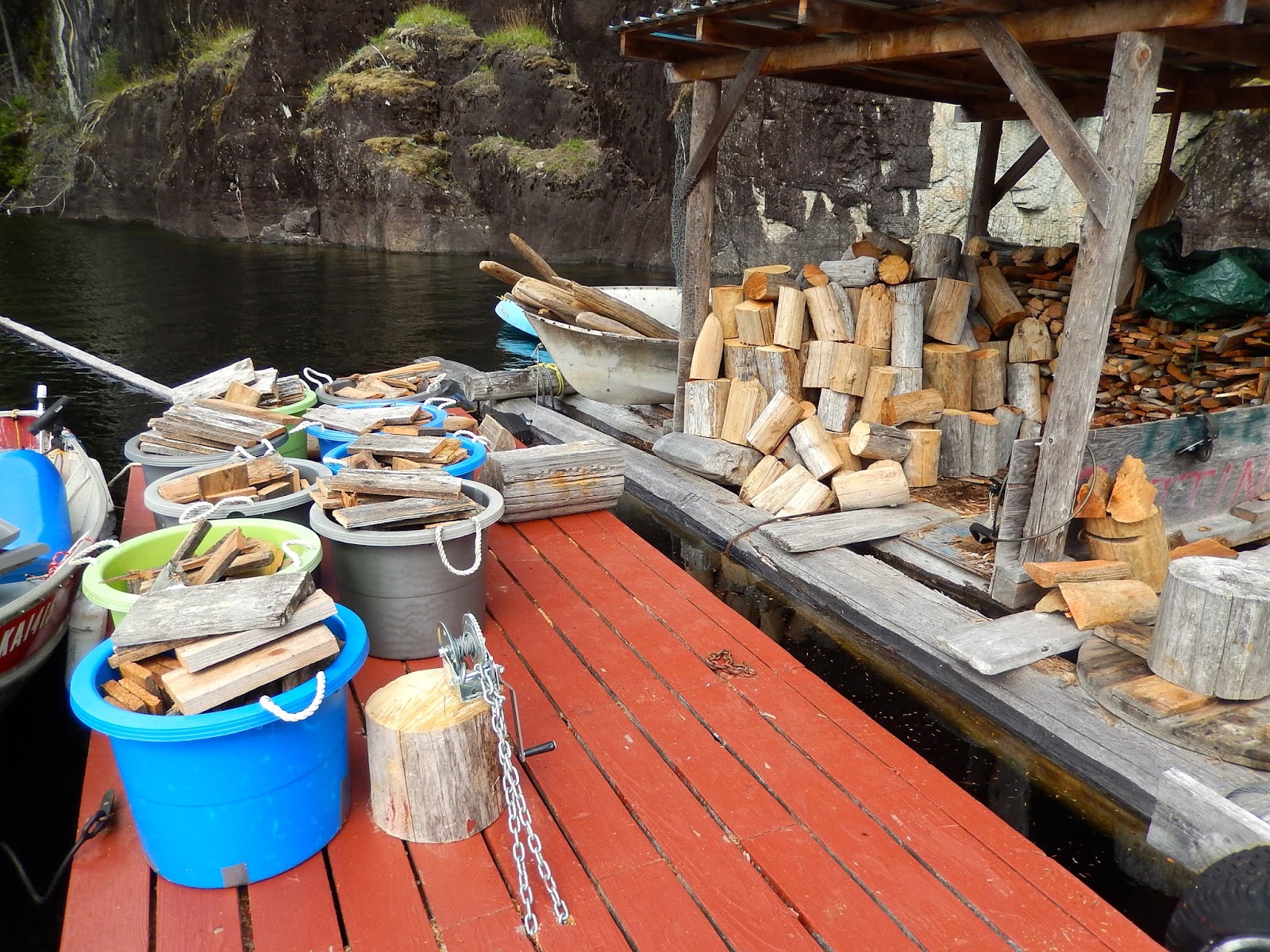
The first step is to get it out of the water. We use the winch Wayne installed to pull our tin boat out of the water. Once the log is on the dock, he can chainsaw it into chunks for drying. Later, we'll start up the log splitter and get it stacked.


Wood in the shed, is like money in the bank. You can never have too much. -- Margy

Wednesday, December 18, 2013

Woodstove Ironing

Our cabin uses off-the-grid sources for electrical power. That really limits the things we can use. Here's a useful chart about the watts needed for common appliances. An electric iron uses 1000 watts to operate. Yikes! That would suck our batteries down in one big gulp.


I got to thinking about other ways to get the job done. In my great grandmother's day they used irons (made out of iron) that were heated on a wood stove. Here's her iron. I still have it. What could I use?


I went to my favourite thrift store, the Economy Shop, in Powell River. I purchased an iron for $2.00 and took it up to the cabin. I wrapped up the cord and placed it on my wood stove to heat.


I used a towel and sheet on my picnic table to make an ironing board. I had to reheat the iron several times, but it worked like a charm. I wouldn't want to use it on delicate fabrics, but for cottons and such it was hot enough to press out the wrinkles, yet cool enough not to scorch. I may end up cutting off the cord. For sure, at 1000 watts, I'll never plug it in off the grid! -- Margy

Thursday, November 14, 2013

Cleaning Woodstove Creosote

Last week I told you about how important our chainsaw is for gathering wood. Without our wood-burning stove, we couldn't live in our cabin year-round. Another important task is maintaining our woodstove to prevent creosote buildup.

Several times during the burning season, Wayne goes up on the porch roof to clean out the external stovepipe. At least once a year, we remove and clean the indoor pipe and scoop ash off the smoke shelf. There are two beneficial reasons. The first, is safety. Creosote can cause chimney fires. Secondly, the fire burns more efficiently, which in turn reduces creosote buildup. Here's what came out of the pipe this time.

I designed a tool to use to help scrape out the horizontal pipes. I call it a Woodstove Sock Puppet. Since we always clean our pipe when there's no fire, it isn't dangerous to you a cloth device. The extra surface area helps Wayne scoop out as much buildup as possible.


Now our woodstove is burning bright, and we're Kozi warm off the grid. -- Margy

Tuesday, November 05, 2013

Stihl Chainsaw Maintenance

This time of year we use our chainsaw a lot. We are gathering wood to store for winter use in our Kozi woodstove.  Some wood we gather from the lake is a burnable kindling size, but to get larger chunks we need to cut small logs for splitting.

Lately, Wayne's saw has been hard to start and struggles when cutting even smaller logs. So he got out the manual for our Stihl chainsaw and broke it down to give it some good maintenance. Over the years, our good friend John has done this for us. But Wayne has learned a lot from him to become more self sufficient.

It was a bit scary to see all those parts on the picnic table. For one thing, a small nut or other part could roll off and fall through the cracks to the lake water below. The other thought was, would it all go back together and run.  But all went well, and we were back to our wood gathering project in no time. -- Margy

Monday, August 12, 2013

Goin' on a Wood Hunt

When we're in the middle of one of the warmest summers we can remember here in Coastal BC, starting a fire in our woodstove is the farthest thing from our minds. But it's a great time to start filling the woodshed, giving the wood plenty of time to dry before the rainy season.  Often wood floats right up to our deck.  Other times it's "donated" by a friend.

Our good friend John refurbished his cabin's boat dock with new cedar boards.  That meant the old ones had to come off and be discarded. We gladly accepted the used wood. Cedar burns well, and the small boards make good fire starters.

Wayne and I first had to remove the old nails, but the wood was soft enough they were easy to pull with a hammer. We saved the good ones for John to use again Save that nail!

Then we cut up the larger boards into stove-size pieces. We carried our booty back to the cabin in plastic tubs.  We split the logs from our last cutting and stacked the new boards in between. That way we will have some with each load we take into the cabin for burning.

Thanks John, for your wonderful donation. -- Margy

Wednesday, March 27, 2013

KOZI Warm Off the Grid

Earlier I shared the wood stove that's the "heart" of our float cabin home. Without its warmth, we couldn't live here in all seasons.

Our stove is a KOZI.  KOZI still makes wood and pellet stoves, but our model is what I lovingly call a classic.  John (you met him last week for the letter "J") found our stove used and refurbished it before installing it in the cabin that would later become ours.

I don't know for sure, but I surmise that the KOZI company chose their name because of how you feel when you cozy up to one of their stoves.  Here's your chance. Hold out you hands and feel the warmth.


How was that?  Makes me think of Christmas.  The local Shaw cable channel runs a fireplace video continuously day and night. -- Margy

Monday, March 18, 2013

Liquid Creosote

If you use a fireplace or woodstove, you know that creosote is the dangerous buildup of smoke and vapor residue in the chimney.  If you burn a hot, fast fire, combustion is more complete and creosote buildup is less likely.  It's when you close down the flue to let the fire burn low and slow that creosote builds up quickly.

When the temperature within the chimney gets below 121 degrees Celsius (250 F), the gases liquify to form creosote.  My Imperial Magnetic Stove Thermometer helps me monitor and control this.

We notice that liquid creosote production is more pronounced when the temperature drops below freezing. This super cools the outside portion of the chimney.

The morning after a particularly clear and cold night, we went outside to discover liquid creosote crud all over our picnic table.

It dripped down through the vertical chimney pipe, out the clean-out hatch at the bottom, and onto the metal porch roof. Because our roofing was recycled, it dripped through empty screw holes and right down onto the picnic table underneath.  Liquid creosote is greasy, dark, thick, and has a strong burned odour.

After a hot fire the next day, the liquid creosote dried up.  But that is also a dangerous condition.  Every other month Wayne goes up on the roof to thoroughly clean any creosote out of the chimney pipe.  Once a year we remove the inside portion to do the same.

Do you use a wood stove or active fire place? How do you take care of creosote? -- Margy