Saturday, January 28, 2012

Wood Rotation

We start using our wood stove for cabin heating in November and keep it going pretty much every day through May. That takes quite a bit of firewood. We try to get our woodshed pretty full in the fall when the wood is dry and lighter, but it's never enough to last the whole season.

Our floating wood shed has two constraints, the size and weight of its contents. If we put too much wood in, the float logs submerge and saturate. That's bad for the logs, and also lets water get to the bottom of our dry wood. Consequently, we have to use a wood rotation system.

This year we were lucky. John redid his cedar deck and gave us all of his old wood. We stored about half of the precut lengths on our log work float. Wayne pushed the float up to the dock and tossed the wet boards across. I tossed them into the woodshed and stacked them criss-crossed so the wood would dry quicker. We have enough dry wood to last another month. By then, our wet would should be ready to use.

Thanks again John. You help us in so many ways. -- Margy

Friday, January 27, 2012

After the Storm

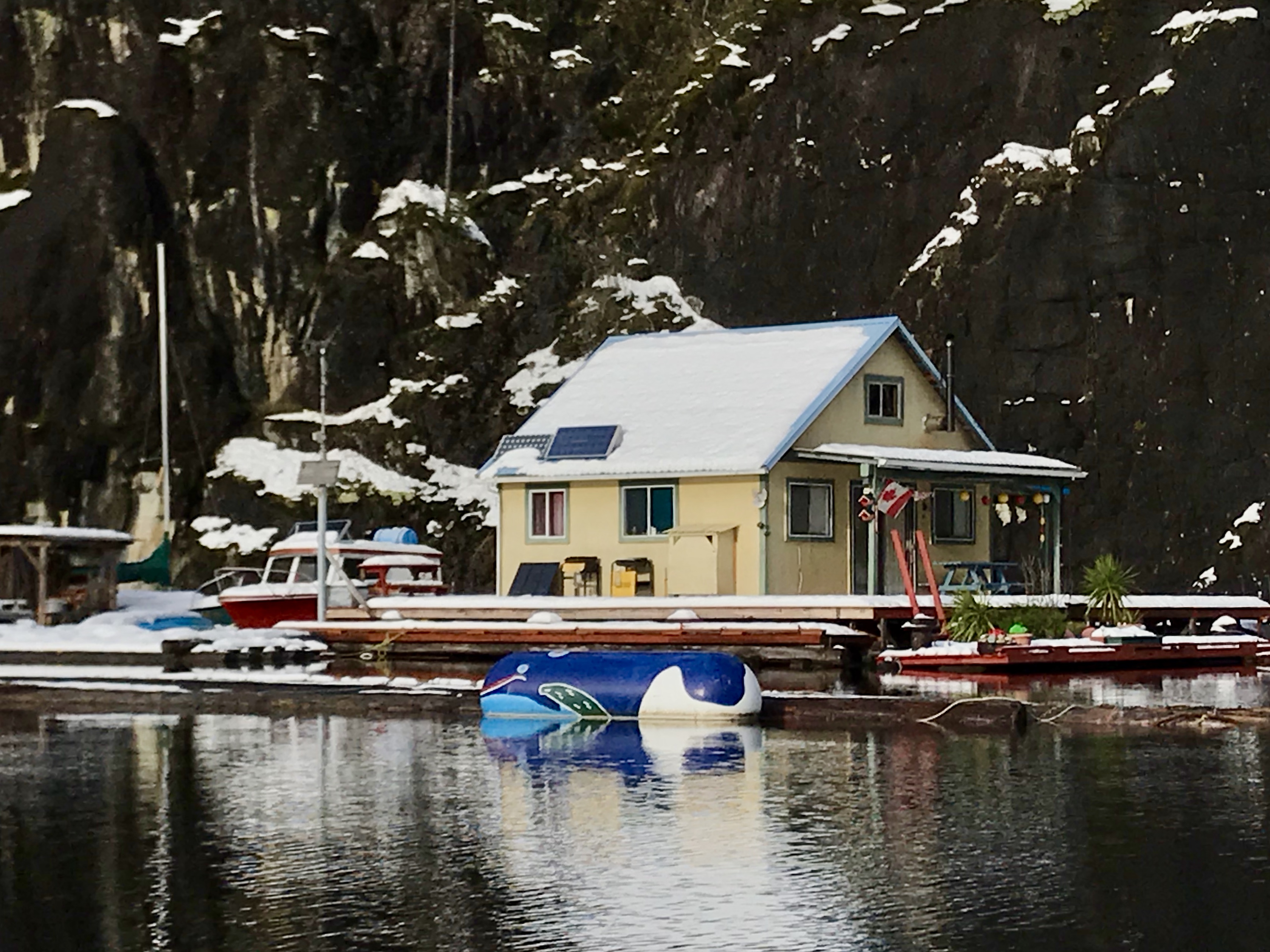
We don't get snow very often, so I love it, especially when we are at the cabin.

Almost as good are the clear blue skies after the storm. Above is a view of my floating garden with Goat Island beyond.

This shot is from our friend John's deck looking up Powell Lake to Chippewa Bay. Want to come visit? There are float cabins for rent by the day and week. But be careful, you may never want to leave.

For great skies from around the world, be sure to visit Skywatch Friday. -- Margy

Thursday, January 26, 2012

Tiny Homes: Simple Shelter

On January 7, 2010, I was surprised to find my garden float featured on Lloyd Kahn's blog. I left a comment thanking Lloyd, and not long after I received a unique request. Lloyd wanted to feature our float cabin on Powell Lake in a new book he was putting together about tiny homes. I was thrilled.

Two years later, Tiny Homes: Simple Shelter by Lloyd Kahn is finished and available for purchase. I've already got my copy and it's an amazing book. It has 1,300 full-colour photos of a wide array of small homemade shelters.

Tiny Homes on Foundations
Tiny Homes on Wheels
Tiny Homes by Architects
Prefabs and Kits
Earthy Materials
Treehouses
On the Road
On the Water (that's me!)

Check out pages 210-211 for Our Little Cabin up the Lake.

Links for more information and purchasing options:
Lloyd's Blog
Shelter Online
Shelter Publications on Facebook
Shelter Publications on Twitter
Amazon.com
Amazon.ca
Check it out online and get a copy for yourself. -- Margy

Wednesday, January 25, 2012

Powell River Books at the Seattle Boat Show

Author Wayne J. Lutz of Powell River Books will be at the 2012 Seattle Boat Show from Tuesday, January 31, through Thursday, February 2.

Author's Book Signing

Tuesday 3:00 to 8:00
Wednesday 11:30 to 8:00
Thursday 11:00 to 2:00

Captain's Nautical Supplies booth at the Centurylink Field (Concourse #2237).

Seminar Presentation
Wednesday, February 1
1:00 p.m. on the Silver Stage


Off-the-Grid Living: Tips for Establishing a Remote Home - Features Boat Access & No Public Utilities


Wayne will be showcasing his newest book Cabin Number 5 which chronicles the building of a float cabin. Also featured will be Up the Lake and Farther Up the Lake about off the grid float cabin living.

Stop by and pick up a signed copies for yourself. Can't make it to the Boat Show? You can purchase Cabin Number 5 and all of the other titles in the Coastal BC Stories series online. Go to www.PowellRiverBooks.com for more information. -- Margy

Tuesday, January 24, 2012

My Snowy World

Last week in Coastal BC we had storms move through that left us with several centimetres of snow on the ground.

I was at the cabin during two of them. Here are the results.


Where we live the snow doesn't last much more than a week, sometimes less.

So I enjoy it when I can get it.

Thanks for visiting part of my world this week. For more great posts from Our World Tuesday, click here. -- Margy

Monday, January 23, 2012

Saving Socks

Dress around the cabin is pretty casual. Summer is shorts and T-shirts. In winter, I bring out sweatsuits and slipper socks.

I've had this pair for several years now. The tops are fine, but the soles have worn through several times. I've had to patch the holes with cotton cloth inside and out more than once.

A cold spot on the ball of my foot told me I had a new hole developing. I hated to give up just yet, so I decided to give them one more lease on life.

I rummaged in the rag box and found old flannel pillow cases. I used the finished edge and there was just enough cloth in one case to make two new soles that are four layers thick.

I sewed the new soles in place with a tight whip stitch. I turned under all the raw edges, and rounded the square corners into the shape of my foot.

My favourite slipper socks have been saved from the trash. It feels good to put them back in use for another winter season.

Have you saved something lately? How did it make you feel? -- Margy

Sunday, January 22, 2012

Morning Comes to Hole in the Wall

The sun's glow just before sunrise ...

makes dark silhouettes of the trees reflected on the calm waters of Hole in the Wall on Powell Lake.

The brow log of our cabin's cedar float foundation still has a dusting of snow from overnight storm. -- Margy

Saturday, January 21, 2012

Rock On with CCRadio

Our float cabin is off the grid. We generate our own electricity using solar, wind, and thermoelectric power, with a back-up gas generator for those short, cloudy winter days. We have chosen not to have television or Internet at our cabin, but we love to listen to the radio.

Wayne did research several years ago and we purchased a CCRadioPlus from the C. Crane Company. It's been a perfect radio for the cabin. It has a built-in battery charger and the four D-cell NiMH rechargeable batteries last for weeks between charges. It has AM, FM, Weather, and TV audio channels. Of course, the TV reception will discontinue once the digital transition is complete.

We decided to treat ourselves to a new CCRadio-2 for Christmas. The old one will stay upstairs, and the new one will be for downstairs and outdoors use. The models are similar, except TV audio has been replaced with 2-Meter Ham. The built-in battery charger has also been omitted. That was a huge surprise. At least our old model can be used for charging the batteries for both sets.

Some of the CCRadio-2 features include:

  • runs on AC or 4 D-cell batteries for 180 hours of run time
  • AM/FM with excellent reception and sound
  • weather band
  • 2-Meter Ham band
  • headphone jack (Wayne loves to listen to late night CBC)
  • pre-set buttons for easy tuning of favourite stations
  • aux-in jack for portable music devices
  • clock and alarm in LCD panel
We're very happy with this product. We can "rock on" with local SUN.FM or keep up with what's happening worldwide. And of course, the fact that it runs on rechargeable batteries makes it perfect for cabin living.

Do you have any rechargeable devices that you recommend for cabin living? Wayne and I would love to hear your suggestions. -- Margy

Friday, January 20, 2012

Pacific Coastal in the Snow

Wednesday I flew from Powell River to Vancouver. The flight was delayed about two hours because of a snow storm moving through Coastal BC.

The pilots of Pacific Coastal Airlines are used to the varied flying conditions in our area. Their experiences gives me confidence in flying in all sorts of weather.


Come fly with me on Pacific Coastal in the snow. -- Margy

Thursday, January 19, 2012

Yaktrax Keep You on Your Feet

Walking on slippery wet, snowy, and icy decks (not to mention docks, sidewalks and roads) can be a huge challenge this time of year. The most recent snowstorm up at the cabin had Wayne and I reaching for our Yaktrax.

Yaktrax Walkers are unique, easy to slip on traction devices for your shoes. They are made in the form of a flexible plastic mesh covered on the bottom with rust resistant metal coils on the bottom.

They work like chains do on a car, making it easier to walk on slippery surfaces.

Wayne leaves his Yaktrax on a spare pair of shoes so they are even easier to put on to go outdoors. While they are meant to be used outdoors, they can be worn inside if you don't have a delicate floor or carpet. That makes them perfect for cabin use.

Yaktrax come in a variety of formats. We have the original Walker version ($20). They also have a Pro version ($30) with over-the-foot straps to hold them in place, an Extreme version ($60) that has mini-chains and spikes on the soles for even better traction, and the new SkiTrax ($20) for use with ski boots.

We've had ours so long I can't remember where we bought them. Check with sporting good stores in your area, or REI or Amazon.ca. -- Margy