Sunday, June 30, 2019

Summer Cabin Visitors

Winter is very quite up the lake at our float cabin home. By late spring, birds and critters start to return. Then as summer starts to settle in, so do they. They come to eat from the abundance in our forest and to raise their young to start a new generation. Two of my favourite visitors are the chipmunks and Oregon Juncos.

An Oregon Junco eating seeds on the bridge to shore

The chipmunks and Oregon Juncos have a symbiotic relationship. The birds flick seeds from my feeders that they don't like down onto our bridge to shore or into the lake.

One of the two resident chipmunks enjoying a snack.

The chipmunks (there's a pair) feast on the fallen seeds in two ways. The easiest is to eat the ones that land on the bridge. They also run along the breakwater logs floating nearby to scoop up the tasty treats that cling at the water's edge. They are so much fun to watch.


Do you have any special animals around your home? Which are your favourites? -- Margy

Thursday, June 27, 2019

Flowering Dracaena Spike Plants

Repurposed BBQ planter in 2010.
In 2010, I repurposed a BBQ into a planter to put under the kitchen window at the cabin to give the side of our home a bright focal point.

I planted geraniums for colour and wanted something to give it height. I picked out two small grass-like plants at Canadian Tire.

Over the years, those spiky little plants (you can barely see them in the picture on the left) grew until their roots took over the whole planter.

The Spike Plants take over in 2015.
Consequently, in 2015 I relocated them to deck pots of their own.

I went back to Canadian Tire to talk to the nursery expert. She wasn't sure what I had, but thought it might be a plant called Dracaena. I looked it up online and that made sense.

The Dracaena indivisa plants get pots of their own.
I believe mine are Dracaena indivisa also known as a Spike Plant. It's commonly used in planters and gardens to provide height and interest. Websites say to bring it indoors for winter, but mine survive outdoors without extra protection even here in Coastal BC.

One Spike Plant developed a floral spike in 2016.


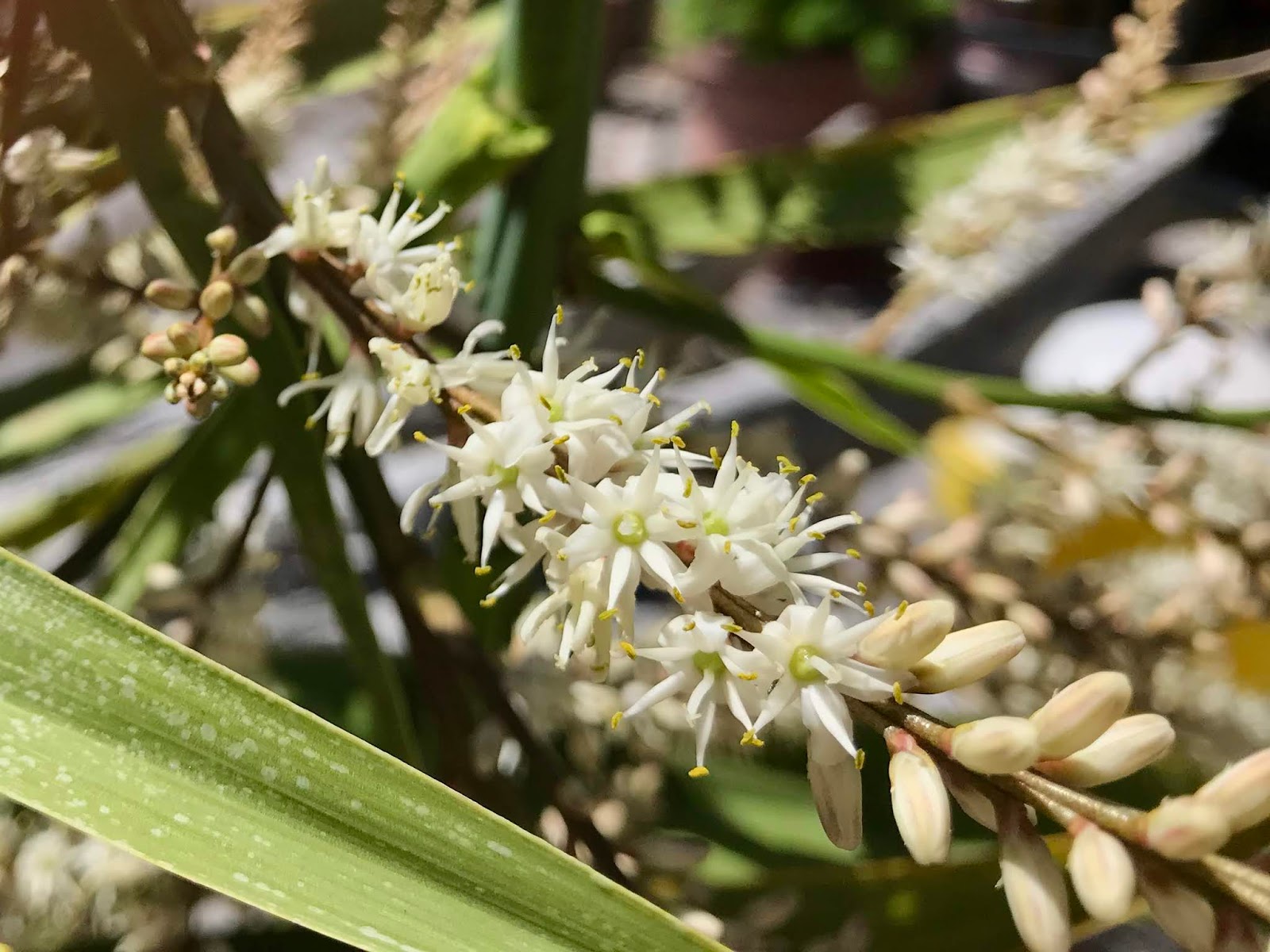
Flower cluster closeup.
In 2016, I was surprised to see one of the plants develop a large central spike. It opened to a massive bloom. It beautiful, fragrant and provided bees with a source of nourishment.

Branching Spike Plant.
Each time a Dracaena blooms, it causes the plant to branch. The plant that bloomed in 2016 now has three branches, and it's partner that started blooming in 2017 has two.

In 2017, I transplanted my Dracaena Spike Plants into larger pots and moved them down in front of the float cabin on our new deck.

2019 plant with two flowering spikes.

This year I was very surprised to find that my late bloomer is trying to catch up. It has two floral spikes rather than one.

2019 plant with one flowering spike.

The Dracaena Spike Plants continue to give us a beautiful focal point. Who would have guessed that those two small grass-like additions to my repurposed BBQ planter would develop into such interesting specimens. -- Margy

Monday, June 03, 2019

"Becoming Wild" by Nikki Van Schyndel

http://www.amazon.com/Becoming-Wild-Living-Primitive-Island-ebook/dp/B00NQDK6RU/ref=tmm_kin_swatch_0?_encoding=UTF8&sr=8-1&qid=1433016598
When I learned an author I've read was going to be on the History Channel Alone: The Arctic TV series, I went to my personal library and got her book out for a second read.

The book is Becoming Wild and the author is Nikki Van Schyndel (Caitlin Press, 2014). I knew it would be a book I would enjoy and wasn't disappointed either time. It's a memoir, it's by a woman who challenged herself to live in a remote location, it's about a region fairly close to where I live in Coastal BC, and includes detailed descriptions of "experiments" and "learnings from Coastal First Nations people" she used to survive.

Nikki, Micah (a man she met during survival school), and her feral cat Scout planned and lived a survivalist lifestyle that spanned two island locations and more than a year in the coastal rainforest of the Broughton Archipelago. When a dilapidated trailer at Native Anchorage on Village Island turn out to be uninhabitable, they erected their own primitive shelter. It was a struggle to find enough food that first winter.

A typical Coastal BC rocky shoreline.

Nikki and Micah had a rowboat they used for transportation, fishing, and to get to Echo Bay on Gilford Island once every month or two to get mail and reconnect with family by phone. After meeting Billy Proctor, a well know resident, they took his suggestion and left Native Anchorage to set up a rustic cabin structure in Booker Lagoon on Broughton Island. Life wasn't easy, but Nikki was able absorb the natural spirituality of the land and sea, ultimately transforming herself into a better person.

Coastal BC has lots of private places to explore.

When the adventure was done, Nikki and Micah parted ways. Nikki and Scout returned to the city, but life there was so foreign after living in nature. She returned to remote Echo Bay, bought property from Billy Proctor and built a log cabin of her own. Billy is a prominent figure in many of the books written about the region such as Full Moon, Flood Tide by Bill Proctor and Yvonne Maximchuk and Heart of the Raincoast by Alexandra Morton and Bill Proctor.

Becoming Wild is available in both print and e-book formats at Amazon and other online booksellers.

For your information, Season 6 of Alone: The Arctic on the History Channel premiers on June 6. Nikki, another Canadian woman named Michelle Wohlberg, and eight other contestants will test their solo survival skills near Great Slave Lake in Canada's Northwest Territories.


You can see more of the The Arctic trailers on YouTube by clicking here. Then check your local television listing to watch it live. Click here for Canadian History Channel information and here for the States.

Also check out her website The Magic, Master and Madness of Wilderness Living where she uses the moniker Daisy Crockett and her YouTube Channel Becoming Wild.

Do you have any off-the-grid or women's survival memoirs to recommend? I'm always looking for a good read. -- Margy

Thursday, May 30, 2019

Spring Gardening Update

Winter carrots and beets gone wild!
Wayne and I got home after six weeks away from our Powell Lake float cabin home. When we left it was early spring and my winter vegetables in the floating garden were good to pick and eat. The weather was cool and rain was plentiful.

While we were gone the temperature rose and rain diminished, only one inch while we were gone. Our good friend John came twice to water, but everything was bone dry by the time we arrived.

My garlic fared well with the dry conditions.

I was amazed at how well the plants were doing under such harsh conditions. For the last three days I've been cleaning up deck containers and the floating garden.

Perennials on the transition float, blueberries and herbs.

Unlike previous years, I won't have a summer garden. I'll maintain my perennials including blueberries, a red currant, herbs, my Dracaena Spike Plants that are getting ready to bloom again, four small cedar and fir trees, and a few containers of volunteer flowers. This will allow Wayne and me to do more cruising on the chuck in our ocean boat.

The floating garden half done.

Watering will still be needed, but not as much and not as often. Plus, it will be good for my soil to lie fallow and allow some of the pests to die off or move on to greener pastures.

Have you even taken a year off from gardening? How did it go for you? -- Margy

Saturday, March 30, 2019

"The Trees in My Forest" by Bernd Heinrich

For Christmas Wayne gave me The Trees in My Forest by Bernd Heinrich. He knows I like books about nature and the outdoors, no surprise after being married on Christmas Eve thirty-seven years ago.

Usually we purchase e-books for our Kindles, but this one is special. It includes hand drawn illustrations of the trees in Bernd's Maine forest. I've become interested in illustrating my cabin journals, so it was a good match for my reading and artistic interests.

Bernd was born in Germany in 1940 and moved with his family to Maine as a young boy. He grew up on a farm and loved exploring nearby forests. Now he's a professor emeritus in biology from the University of Vermont and lives between a home in Vermont and a cabin in his western Maine forest.

Fungi, moss and lichen at work in our forest.
After starting with a forestry emphasis at the University of Maine, Bernd switched to biology at UCLA, followed by teaching entomology at UC Berkley. In 1977, he returned to Maine and purchased three hundred acres of former farmland and logged hills. It included a varieties of ecosystems including a steam, swamp, hills, a granite ledge, former pastureland, and a cabin.

A pine reclaiming a Powell Lake forestry road.
Bernd walks us through his property and chronicles change from acquisition in 1977 through the late 1990s. Logged areas and farmlands have regenerated into natural woodlands. He points out the relationships between trees, smaller plants in the understory, fungi, insects and animals. While most of the book is descriptive, there's enough science mixed in to teach the reader something new.

Our cedar, alder, maple and granite outcrops.
Since I live in a logged and forested region, Bernd's story was both engaging and informative. While the trees differ from Maine to Coastal BC, there are some commonalities. We have pine, hemlock, fir, cedar, broadleaf maples and alders. Bernd has spruce, fir, aspen, alder, birch, several varieties of maple and apple trees gone wild. He has granite ledges, even though ours are more prominent.

I enjoyed this book so much I purchased A Year in the Maine Woods. In this earlier work, Bernd settles into a log cabin on his wooded acreage with his pet raven. I don't see any problem reading these books out of order. It will be like a prequel, so popular in films these days.

The Trees in My Forest (Ecco, 1998) by Bernd Heinrich is available online at Amazon and most other online booksellers.

Do you have any books about nature, off-the-grid living or adventure to recommend? I'm always looking for a good read. -- Margy

Tuesday, March 26, 2019

Readying My Mason Bee Hotels

Last week I was a guest author about Mason Bees on Farmgal's Just Another Day on the Farm. You can read about it and find links to my previous Mason Bee posts by clicking here.

We just came home after two months away. In my recent post Back Up the Lake I speculated about what we might find.

One thing I was anxious to check was my Mason Bee nesting blocks.

Repainting the Mason Bee Hotels,
Mason Bees start emerging from their cocoons in March. It's a fun process to watch and I hoped I hadn't missed it. Even before I went inside the cabin, I looked at my Mason Bee winter storage box on the side porch. It's a cool spot that only gets a wee bit of sunshine. All was quiet.

I took the opportunity to refurbish my two bee hotels.

The refurbished Bee Hotels with their nesting tubes.

Nesting blocks filled with cocoons.
They haven't had any maintenance since they were repurposed from old birdhouses and attached to a south-facing post on our front porch. The fresh paint not only made them look better, but helped preserve their fiberboard construction for a few more years to come.

Wayne helped me moved the heavy winter storage box to a spot under the porch near the Bee Hotels. It will be protected from any spring showers, yet it will be close enough to the hotels for nesting.

Commercial Mason Bee nesting tubes.
My drilled wood nesting blocks are all full of cocoons. I needed something quick and easy to use for the emerging bees. I chose Milliard cardboard Mason Bee nesting tubes. I prefer the homemade wood ones because they are safe to be left outdoors in a protected spot. Mice love to chew cardboard tubes, so they have to be stored either indoors (in a cool spot) or in a protective container outdoors.


Now the full nesting blocks and the refurbished Mason Bee hotels are on the south facing side of our front porch. The recent warm weather and sun are sure to give them the clue that it's time to emerge.

Do you have nesting places for native bees. It's fun and easy. Here's an online resource to use to get started. Also, plant pollinator friendly flowers in your garden. Bees need all the help we can give them. -- Margy

Friday, March 22, 2019

How to Build a Mason Bee Hotel Series

Te first of a three part guest post series.
Earlier this month, I made a comment on Farmgal's blog Just Another Day on the Farm. It was a post about ordering Mason and Leaf Cutter bee cocoons and an interesting viewing house to watch all the action inside. That led to an invitation to write guest posts about my Mason Bee hotel experiences. Click the links below to read the posts.

Monday was the first of three guest posts in Farmgal's How to Build a Mason Bee Hotel Series. It tells how Wayne and I made nesting blocks by drilling pieces of driftwood.

Wayne helped me drill the holes part way through the blocks.

Tuesday's guest post focused on how we repurposed old birdhouses into Mason Bee hotels to hang on our front porch's south facing post.

Giving the old birdhouse a facelift with new paint.

Wednesday's guest post focused on attracting mason bees and caring for their nesting blocks through the year.

We mount the Bee Hotels on a south facing surface.

If you would like to read my original Powell River Books Blog posts in their entirety, please click on the links below.

Building a Simple Mason Bee Hotel
Drilling Nesting Blocks for a Bee Hotel
Bee Hotel Update
Revitalizing a Bee Hotel

It all started in 2015 with two native Mason Bees nesting behind a small solar panel on our front porch.

The two original Mason Bees nesting in a crevice on the front porch in 2015.

Each year we've expanded the number of nesting blocks to accommodate all of the bees we are helping to multiply. That's good for my garden and for the natural surroundings where we live.

Chickens pictured on Farmgal's blog.
Thank you Farmgal for letting us share our experiences.

I encourage you to get to know Farmgal. She's a fellow Canadian who lives on a farm near Ottawa. You can find her online at:

Just Another Day on the Farm
On Twitter as @farmgal1800
On Facebook Just Another Day on the Farm
And Farmgal for Hire

Do you have a Mason Bee hotel or nesting sites for other natural bees? Do you raise honeybees? What are your experiences? All bees need our help so they can continue to help us! -- Margy