Saturday, December 13, 2014

Telus Wireless Internet with USB Key

Laptop with Telus Huawei LTE Internet USB key.
With our new cellular signal booster system, we wanted to get wireless Internet at the cabin for our laptops. Wayne's phone has a Telus plan, so we added data.  We chose the Mobile Internet FLEX. It starts at $10 a month for 100MB. With our limited email and Internet needs at the cabin, we have made it through a month.

Connection Manager gives you status reports.
But if you go over, it bumps to $30 for 500MB, $45 for 2GB. Flat rate plans start at $40 for 2GB, use it or lose it. Because our use varies, the FLEX plan is best.

Telus offers a free Huawei LTE mobile internet key with a two year contract. It's not cutting edge technology, but fits our laptop needs.  The onscreen Connection Manager lets you monitor session usage.

A nice feature of the Internet key is that it works anywhere you can make a Telus connection, even out on anchor.

Thing I can't do at the cabin are posting to my blog or visiting my online friends. For that, I have to go to town, and then it's a reading and writing binge. -- Margy

Friday, December 12, 2014

Wilson Signalboost Desktop for Cellular and Internet

Signalboost Desktop wireless at cabin.
If you follow our blog, you know Wayne and I haven't had Internet at the cabin. It was a decision to keep our lives simple. Now that we are at our floating home for longer stretches, we've decided to make a change.

We don't need high speed access, but want to check email, download a newspaper, and look up important stuff. None of those when used carefully are upload or download data hogs.

Pole mount of external antenna.
We researched satellite Internet. Two in our area are Galaxy and xplornet. We didn't choose that option because of cost and our remote location. We choose our Telus wireless provider. For limited use, it turned out to be the cheapest solution.

First, we had to figure out if we could get a signal. We live on the ragged edge of cell coverage for Wayne's old digital phone, and my iPhone doesn't work. The Telus office sold us a cell booster, let us test it, and return it if it didn't work without a charge. The total cost for a compete package was about $350 CAD.

Powered signal amplifier connects to outdoor antennae.
The cell booster was the Wilson Signal boost Decktop. Wayne did a temporary installation and we could get an adequate signal for our purposes. It allows us to pick up 4G. If not, it automatically steps down to capture whatever signal is available.

We mounted the external antennae on the pole we use for our wind generator. It points the the unit for best line of site to "Telus Mountain" about 11 kilometres (7 miles) away as the raven flies.
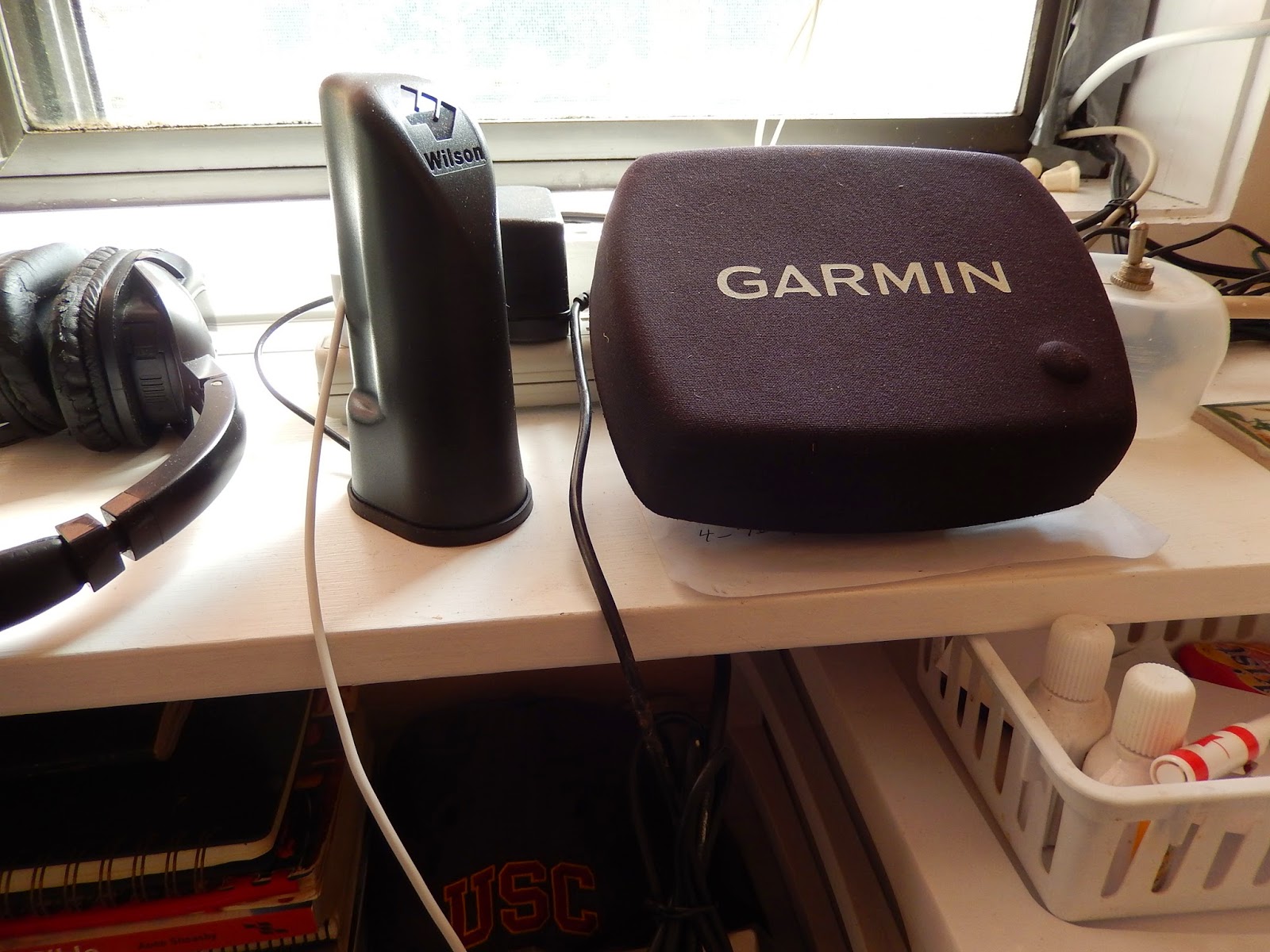
Indoor antennae.
Coaxial cable connects to the indoor signal amplifier. It needs AC, so we use it when our solar system is working. At night, we can turn power back on if needed.

Connected to the signal booster is the indoor antenna. This component also has an AC power connector. Fortunately, the indoor units have a low draw.

One bonus of our system is that my iPhone now works for cellular service. Despite what the specifications say, we need to be within a few feet of the indoor antennae for a good connection. This may be affected by the very low signal we actually get from Telus at our location.

In the next two posts I will tell you about our Internet plan and how we can connect our laptops directly to the Internet. -- Margy

Wednesday, December 10, 2014

Coastal BC Plants: Vancouver Groundcone

Vancouver Groundcone

Last spring, up on the cliff near my garden plot, I noticed an unusual plant pushing out of the ground at the base of a fir tree.

Using my guidebook, I identified it as a Vancouver Groundcone. It's a parasitic herb that grows with salal and obtains nutrients from its roots. While this specimen was pushing its way through the duff at the base of a tree, it was right next to a big patch of salal.

Vancouver Groundcone grows to about 12 cm (4.7 in) in height from a thick underground tuber that was sometimes eaten raw by First Nations people. They come in red, yellow and purple. Mine were a rich golden (almost pinkish) yellow. These are the first I've noticed, but the book says each one produces 300,000 plus seeds. I may be seeing more soon.

Are you interested in plant identification? I use Plants of Coastal British Columbia by Jim Pojar and Andy MacKinnon. I like it because it includes trees, shrubs, wildflowers, aquatics, grasses, ferns, mosses, lichens and, of course, some oddball (and very interesting) plants. In addition to the color pictures, line drawings, and identification information, the narratives include how the plants were used by First Nations people and early settlers. I highly recommend it for the casual observer as well as experienced botanists. -- Margy

Tuesday, December 09, 2014

Driftwood Santa Wall Hanging

A bit of the cabin for Christmas in town.
Does wood ever speak to you? Sounds silly, but every time I pick a piece of driftwood out of the lake I listen to what it has to say. Most often it's, "I just came by to help you keep warm this winter."

But other times, driftwood has a different message. Stumps beg to become floating planters. Medium sized gnarly pieces ask to come aboard to decorate our deck. Smaller piece often have a unique message of their own.

This piece of driftwood told me it wanted to become a Christmas decoration we could bring out each year to celebrate the holiday.

I must be honest, I'd just seen an article in the Peak advertising a local crafter's wares at Artique, the local artist cooperative shop. When I saw this piece of wood float by, I knew what it would become.

All it took was some acrylic paint, yarn to make a ball for the top of Santa's hat, and two nails and a piece of yarn on the back for a hanger. The driftwood shape was perfect just the way it was for the task.

I enjoy using handmade decorations for the season, and my driftwood Santa wall hanging fits right in.

Are you making anything special for Christmas this year? -- Margy

Sunday, December 07, 2014

Waiting for the Cut

Logging boom pen waiting for the next cut.

A crisp fall day at the Goat Island Dunn dock on Powell Lake, BC. -- Margy

Friday, December 05, 2014

Cabin Cooking: Egg Substitutes

Christmas baking is coming. One of the things I will need, but sometimes run out of at the cabin, is eggs. When that happens, it's a long trip down the lake by boat, or I need to find an alternative. So here are some egg substitutes I've used.

I did some Internet research and here are two substitutes if you get caught eggless.

1 teaspoon yeast
¼ cup warm water

Or

1 ½ tablespoon water
1 ½ tablespoon oil
1 teaspoon baking powder

I've used both with mixed degrees of success in cake and quick bread recipes. Eggs provide leavening, so substitutes try to replace this feature. What they cannot do is replace the richness, colour, and flavor real eggs bring to baked products.

If you want to read more about our float cabin living on Powell Lake in British Columbia, go to www.PowellRiverBooks.com.  There you will find a list of Wayne's books in the Coastal BC Stories series. Many include chapters about our cabin life, and right now the Kindle version of Up the Lake is FREE. -- Margy

Tuesday, December 02, 2014

Return to Goat Island by ATV

Click to enlarge for details.
Fall is a good time to go quad riding in the Powell River back country. We used a recent cool, sunny day to head out in our barge. With short days we couldn't go far and still have enough sunlight to ride, so we chose nearby Goat Island.

Clover Barge Ramp
There was no logging activity, so we could use the Western Forest Products barge ramp and dock. There's a lot of activity on the lake with hunting season open. We've seen people taking their quads and motorcycles up on landing crafts, barges, decks of houseboats, home-built barges and rafts, and squeezed into regular boats.

Clover Lake
You can be sure we kept both eyes and ears out for hunters during our ride. The first leg of our journey took us north on Clover Main. We've traveled this section of road before, but not to the end. Along the way we stopped at the quad trail heading down to the mouth of Clover Lake. It's a good road, but we decided to hike down.

Bad move with all the runoff and muddy puddles. We'll know better for next time.

We did discover why they call it Clover Lake, lots of clover growing in the area.


As we progressed north, the road went from active to not used in many, many years. We retraced our steps at the ends of spurs, and continued as far as the alders, cedars and firs in the roadbed would allow us to travel. I think the old roads are really pretty to ride.

We turned around and headed back down Clover Main. At the main junction we continued south to find the opening to Elvis Main. This section of road is named after the King of Pop who stands proudly on the point, also named in his honour.

Riding a section of Elvis Main on Goat Island.
This logging road hasn't been used for quite some time, and is being quickly overgrown. But we were able to wind our way around trees and bushes to make it to the end of the road. Unfortunately, we couldn't make it all the way to the Elvis statue without a slog through the bush, and there wasn't enough sunlight left for that.  I'll tell you more about Elvis and his new Graceland home in a future post. -- Margy