Wednesday, October 28, 2015

Coastal BC Plants: Pearly Everlasting

Pearly Everlasting

Just about everywhere you go along roads in the Powell River backcountry you'll find Pearly Everlasting (Anaphalis margaritaea). It’s nice to have a flower that’s almost a namesake: Margy, Margaret, margaritaea.

You can find Pearly Everlasting on rocky slopes, in open forest areas, clearings, meadows, fields; pretty much any sunny spot from low elevations to sub-alpine heights.


Like many other plants in the Aster family, it’s a perennial herb. Many straight stems rise from an underground rhizome (versus a root), allowing it to survive through the winter to regrow each spring.


The narrow lance-shaped leaves are greyish-green on top and white underneath. The round white flowers, looking much like handfuls of pearls, grow in clusters at the top of each stalk. When picked and dried, they last a long time in flower arrangements, pretty much “everlasting.” -- Margy

References: Plants of Coastal British Columbia by Jim Pojar and Andy MacKinnon (Lone Pine Publishing, 1994) and Wildflowers of the Canadian Rockies by George Scotter and Halle Flygare (Hurtig Publishers, 1986), and E-Flora BC: Electronic Atlas of the Flora of British Columbia (online).

Monday, October 26, 2015

RIP Mr. Ducky

We came home from a trip to town to find Mr. Ducky pulled out of the water and lying deflated on the transition float deck. We'd had a storm, so finding him out of the water wasn't unusual. We can get some heavy winds here on the lake.


We went down and discovered a disconcerting fact, the back of his head looked like something took a big bite out of the plastic. The edges of the "wound" at triangular points. What could have done that? Rubbing against the dock didn't seem like the culprit.

Then we turned him over and there were puncture holes in his plastic bottom. Did something with claws grab him and take a bite out of his head? Poor Mr. Ducky!

We'll never know what really happened. If I had a trail camera, it might have solved the mystery. I bet you can guess what I'm going to ask Santa to put in my stocking.

So, rest in peace Mr. Ducky. We'll miss your sunny face and happy smile. Maybe Santa will bring one of your cousins to swim in our lake. We promise we'll take better care of him. -- Margy

Sunday, October 25, 2015

Woodstove Cooking: Easy Stovetop Chili

Evenings are cool, so the Kozi woodstove is usually fired up to warm the cabin. On those nights, I like to use the "free" heat to cook dinner. One recipe that's easy to make is stovetop chili because I usually have all of the ingredients as staples on the shelf at my cabin.

Easy Stovetop Chili

19 oz (540 mL) can red kidney beans drained
14 oz (398 mL) can green beans diced
19 oz (540 mL) can tomato juice
½ small onion chopped
¼ bell pepper chopped
2 cloves garlic chopped
1 package chili seasoning mix
1 tablespoon chili powder
1 teaspoon cumin
½ lb ground beef cooked

First crumble and cook the hamburger in a heavy metal pot. Drain fat if needed. Add all remaining ingredients including the liquid from the green beans. Cover and return the pot to the stovetop. Cook slowly for about an hour or until thick and bubbly. Stir frequently, especially if you are using a woodstove and the fire is hot. Add water as needed. Substitutes I use for hamburger include one 5 oz (or 184 g) can of chicken or turkey, or leftover meat chopped or shredded.

I like to make fresh bread on the same day to complete the meal. My Buttery Sourdough Pan Rolls are a good choice.

Follow this link if you want to see the recipe. -- Margy

Monday, October 19, 2015

Olsen Valley Homestead

Four klicks up Olsen Main from Powell Lake
There's history all over the Powell River backcountry. Sliammon First Nation people have lived here for millennia. Intrepid explorers such as Vancouver and Juan Francisco de la Bodega y Quadra followed in the late 1700s. Then came the traders and colonizers. Finally individuals, families and companies who were attracted to our natural resources including timber, fish, and water.

Take a left spur through a deep culvert.
The Powell River Paper Company built a pulp and paper mill at the mouth of the Powell River in the early 1900s. A town was created for mill workers, and loggers branched out into the surrounding area to supply wood for the enterprise and to sell in Vancouver to support the burgeoning building industry. Entrepreneurial people followed forest workers into new areas to create farms to grow food for the new industries.

Olsen River 1/10th of a klick from homestead.
On a recent quad ride, Wayne and I went to the site of an elaborate homestead in Olsen Valley. This fertile area was once home to a cluster of families with elaborate houses and farms. The crops they produced were taken down to Olsen's Landing (the same spot where we offloaded our quads from the barge) and from there by boat to Powell River. The Olsen Valley community grew large enough to build their own school. Everyone thrived until 1955 when the mill diverted water from the Theodosia River into Olsen Lake to increase the flow into Powell Lake for power generation at the Powell River dam. The settlers left, and their abandoned homes were destroyed in 1972 to discourage hippies from moving back to the land.

One of many rock retaining walls.
Wayne stumbled onto the foundation of an elaborate homestead only four kilometres up from Olsen's Landing on a logging spur. It was evident he wasn't the first because the area had been cleared and arranged to make the historical site more visible. With my love of "treasures" he knew he had to take me there.

For more information about Olsen Valley, here are a few online resources you can check out.

Olsen Valley - Powell River Historical Museum
Olsen Valley Homestead - www.vanishinghistory.ca
Olsen Valley Homestead Layout Picture - www.vanishinghistory.ca
Olsen Valley by Dave Hurrie - www.vanishinghistory.ca
Olsen Valley Additional Pics of 1970s - www.vanishinghistory.ca
Olsen Valley by John - www.vanishinghistory.ca
Olsen's Landing - itsmysite.com

It's wonderful that people have left the artifacts in place so those of use who follow can imagine what life was like in this beautiful place. Here are a few of the highlights.

Items displayed on cement and rock foundation.
Piping inside of foundation.
Stairs leading down into the cellar area.
Household items on display.
Cement sidewalks around the home site.
Cement stairs leading down to a level area.
Old saw and equipment on display.
Lots of old vehicle and equipment parts.

There were so many things to see we will need to return. -- Margy

Saturday, October 17, 2015

Coastal BC Insects: Cardinal Meadowhawk

Cardinal Meadowhawk

Nanton Lake, BC
Wayne and I were kayaking on Nanton Lake when I got a hitchhiker on the towel I use to keep sun off my lap. The dragonfly was quite large and bright red.

After some research, I believe it was a Cardinal Meadowhawk (Sympetrum illota). Meadowhawks are common in British Columbia. Cardinal Meadowhawks are found flying more often late in the summer season. Based on the brilliant red colour of my guest, I think it was a male. Females are also red, but not quite so intense.

Cardinal Meadowhawk dragonfly resting on my kayak.

They can be seen flying around ponds, parks and yards. Meadowhawks rest with their transparent wings held in a forward position. Look for them on the ground, low plants, or even moving kayaks.

Dragonflies either mate in flight or while perched on plants. The eggs are either dropped from the air, or placed in the water as the female swoops down, touching the surface. Larvae hatch to become aquatic nymphs before going through metamorphosis into their aerial adult form. The nymphs (naiads) feed on tadpoles, invertebrates, and even small fish. Adult dragonflies feed mostly on flying insects including their brothers, sisters, and cousins. -- Margy

References: Bugs of British Columbia (Lone Pine Publishing, 2001) by John Acorn and Ian Sheldon, and Insects of the Pacific Northwest (Timber Press Field Guide, 2006) by Peter Haggard and Judy Haggard, and E-Fauna BC: Electronic Atlas of the Wildlife of British Columbia online.

Wednesday, October 14, 2015

Coastal BC Plants: Narrow-Leaved Bur-Reed

Narrow-Leaved Bur-Reed

Narrow-Leaved Bur-Reed in Nanton Lake, BC
Narrow-Leaved Bur-Reed (Sparganium angustifolium) is a common aquatic plant in Coastal BC ponds, along shallow lake shorelines, and slow moving streams. The rhizomes are anchored to the bottom and stems and leaves are both submerged and floating on the surface. It creates dense underwater jungles and mats with its long, thin leaves.

At the time we were there, no flowers were visible. Male flowers are on the upper portion of the stem rising out of the water. Female flowers form rough round heads that look like burrs. They are found on the lower portion of the same stem. That arrangement, and growing close to neighbouring plants promotes fertilization.


The burr like fruits and reed shaped leaves give these plants their common name.


Wayne and I saw lots of Bur-Reed on our kayak trip on Nanton Lake near Powell River. It was most prevalent in the back bays and along the shallow shoreline. Because the water level was low, the leaves were very visible floating on the surface. -- Margy

References: Plants of Coastal British Columbia by Jim Pojar and Andy MacKinnon (Lone Pine Publishing, 1994), Wild Berries of the Pacific Northwest by J.E. Underhill (Hancock House Publishers, 1974), and E-Flora BC: Electronic Atlas of the Flora of British Columbia online.

Saturday, October 10, 2015

Never Give Up on a Good Picnic Table

Wayne writing at the picnic table with its winter enclosure.
When we purchased our cabin in 2001, it came with a bright red picnic table handmade by our good friend John.

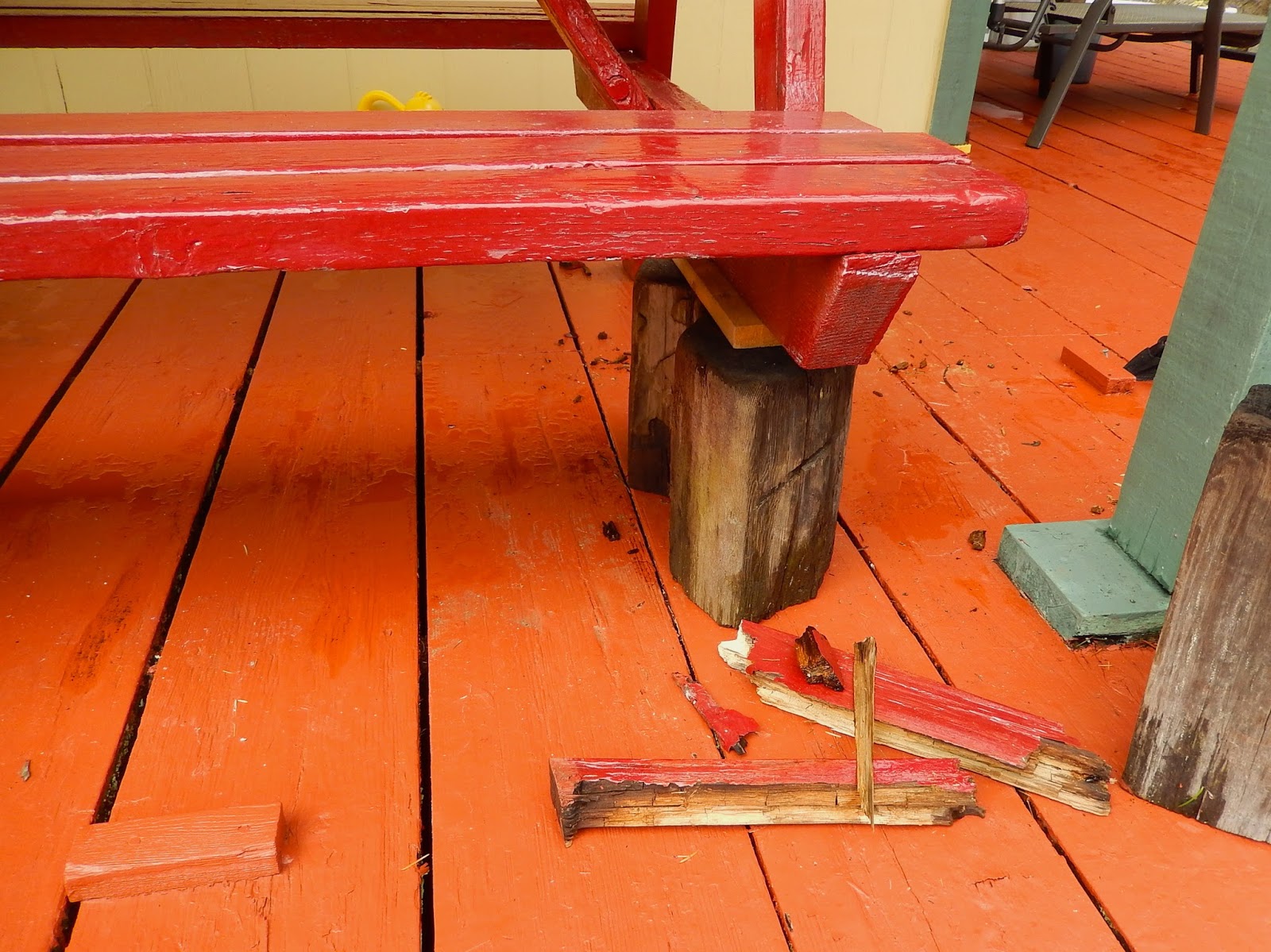
Over the years it's had lots of use for meals, crafts, gardening chores, chainsaw sharpening, and Wayne's writing projects. In 2007, our table had it's first catastrophe. It lost two legs to wood rot (Leg Surgery for a Picnic Table). I guess it's termed dry rot, but in this case it was more like wet rot. John came to the rescue and gave it two new legs to stand on.

Over the years benches and tabletop slats have been replaced a few at a time, and Wayne has added multiple coats of paint to keep out the wet. Not much of the original table remains, but we don't want to give up on it. Like the Seven Million Dollar Man, "We can rebuild him. We have the technology. We have the capability to make [him] better than he was before," so to speak.


But it's happened again. Another leg has broken. I sure wish John had patented those picnic table socks to help prevent wood rot. Wayne searched through our supply of old shake blocks and found one that would provide a temporary fix until John can build us a new bionic one. -- Margy