Thursday, July 30, 2015

Our Hole in the Wall Cabin on CBC Radio

Wayne and I are honoured that Willow Yamauchi from CBC Radio selected our float cabin home to be part of a radio rebroadcast about alternative homes in Canada called "Out of the Box" that will air during the BC long weekend.

CBC Radio One
Monday, August 3
5:00-6:00 pm

In addition to our Powell Lake float home, the hour long presentation includes Canadians living in a yurt, earthship, cob house, and converted shipping containers.

In addition to the radio program, the CBC News for British Columbia website published a very nice article about our cabin to go along with the radio program.


Our portion of "Out of the Box" was a rebroadcast of a 2013 interview with Willow Yamauchi (who grew up in nearby Lund). You can read more about that program here.

There isn't an online link to the whole "Our of the Box" program, but you can hear my portion that originally aired on the CBC show "North by Northwest."

Click here for a link to the interview portion of the program. NOTE: The audio player will come up in a separate window. -- Margy

Wednesday, July 29, 2015

Coastal BC Plants: Wild Chicory

Wild Chicory

Along the roads and trails right now there are some beautiful flowers reflecting the hue of the summer blue skies.


I stopped to take some pictures of the Wild Chicory plants. I even captured a buzzing bee gathering a bit of nectar.

I did some research and learned that Chicory (Cichorium intybus) is a perennial herb that is native to Europe and the Middle East. It was later introduced to North America and has now become "naturalized" to our locale.

I've heard about Chicory from my parents who had to drink it as a coffee substitute during World War II, but I never made the connection to this lovely flower, or the fact that it is related to cultivated versions such as Belgian endive and radicchio.

So if you are out walking or hiking, keep an eye out for this lovely blue flower. -- Margy

Tuesday, July 28, 2015

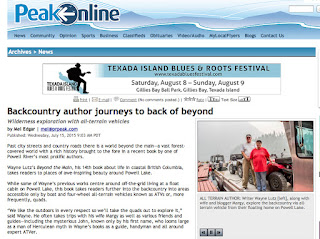
"Beyond the Main" Highlighted in Powell River Peak

Mel and Wayne heading up the lake.
A few weeks ago, Mel Edgar, a reporter from the Powell River Peak, came up the lake to our float cabin for an interview about Wayne's newest book in the Coastal BC Stories series called Beyond the Main. The book was a catalyst for a conversation about ATV riding in Powell River, and quad riding in general.

http://www.prpeak.com/articles/2015/07/15/news/doc55a5a36ca8991569095758.txt
The article entitled "Backcountry author journeys to back of beyond" was published in the Wednesday Peak on July 15. You can click on the image at the left, or this link to read it online.

In addition to our quad experiences, the article had lots of information provided by members of the very active Powell River ATV Club. If you are interested in getting in touch with the Club, you can contact Ted Wrubleski at wrublet@telus.net.


Wayne and I aren't expert riders (yet), but we do enjoy exploring the many logging roads and trails built in the Powell River backcountry.

http://www.amazon.com/Beyond-Coastal-British-Columbia-Stories-ebook/dp/B00VSHAVNU/ref=tmm_kin_swatch_0?_encoding=UTF8&sr=&qid=You can read about some of our recent adventures in Beyond the Main. It's available locally in Powell River at Coles or Breakwater Books. It's also available online at Amazon.com and many other booksellers in both print and e-book formats.

Right now there's an introductory $2.99 special for Kindle readers at Amazon.com. We hope you'll check it out. -- Margy

Saturday, July 25, 2015

Coastal BC Insects: Lorquin’s Admiral Butterfly

Lorquin's Admiral

Posing for the photo shoot up close.
Lorquin’s Admiral (Liminitis lorquini) is a large butterfly found throughout the Pacific Northwest. It’s black in colour with a band of large white spots across the middle both wings and orange tips.

I saw my first specimen at the cabin in June 2015 while it was exploring our front porch. When I went out to see if I could get a picture, it landed next to me and crawled onto my foot, just begging to be photographed.

Checking out our log raft,
Lorquin’s Admiral butterflies live on nectar from flowers.

They are often seen sunning on the ground or plants, and are drawn to moist soil where they sip for nutrients, primarily sodium which they cannot derive from nectar.


Resting in the shade.
Eggs are laid on willow, cottonwood, plum and cherry trees. The larva creates a unique structure called a hibernaculum from a leaf stem and silk threads that they generate. Inside the hibernaculum, it spends the winter, but on occasion will exit to sun itself on the nearby branch.

http://www.amazon.com/Bugs-British-Columbia-John-Acorn/dp/1551052318/ref=sr_1_1?ie=UTF8&qid=1436737887&sr=8-1&keywords=bugs+of+british+columbia
A useful guide for common butterflies and insects is Bugs of British Columbia (Lone Pine Publishing, 2001) by John Acorn and illustrated by Ian Sheldon. John has a Master’s degree in Entomology from the University of Alberta. The descriptions have interesting facts and are written with adults and young adults in mind, or as the author says, “bugsters.” The colour illustrations by Ian are large and with enough detail to assist in identification. -- Margy

Wednesday, July 22, 2015

Coastal BC Plants: Himalayan Blackberry

Himalayan Blackberry

The Himalayan Blackberry is prolific along the south coast of British Columbia and Vancouver Island. It's an invasive species that grows in thickets and crowds out other local plants. As the name indicates, it is native to Asia that was introduced in the Pacific Northwest for fruit production, but they have spread and gotten out of control.

In our area, the white blossoms start to form into small hard berries in July. By August, they are ripening to large, juicy, sweet berries begging to be picked. This year is going to be particularly early with all the not weather we've had.

I know that they are an invasive species that can clog riverbank, or engulf huge areas, but when you can pick such luscious fruit for free and make it into so many wonderful things, it's hard to hate it. Just look at this bowl full or wonderful fruit.

Wild blackberries are used to make lots desserts and preservatives. I usually pick a nice big crop at the Shinglemill Marina before coming up the lake. At home in the cabin I make them into pies, cobblers, pancakes, jam, and canned whole to enjoy all winter long.

Each year in August, my hometown of Powell River celebrates all the wild blackberries that grow in every nook and cranny with a Blackberry Festival and Street Party. It's such fun. They block off about a kilometre of Marine Avenue and local vendors and restaurants set up booths and street performers entertain.

Do you have Himalayan Blackberries where you live? How do you like to use them? -- Margy

Tuesday, July 21, 2015

National Weather Service Rain Gauge

This summer we had a guest at our cabin. John used to teach with Wayne at Mt. San Antonio College in Walnut, California. He's an avid pilot and motorcyclist. This year he came north on his bike.

John's a retired Fire Captain. His station was responsible for providing the US National Weather Service with updates including measuring the amount of rain. When equipment became obsolete, they gave it to him.

Painting the outside of the massive rain gauge.
John knows how much Wayne enjoys monitoring the weather. They were both aeronautical instructors teaching aviation weather courses. John had an extra antique rain gauges, so he loaded it on his bike before heading north.

The bronze gauge was in excellent condition, but silver paint on the outside was peeling. Wayne sanded it and added a new coat.

Next was a mount for the cabin deck. We can get some nasty winds. Our other good friend John took on the task. He tried every plumbing and builders supply store in town. John never gives up. He went to the auto wreckers and found what he needed, but the pipe was crushed.

Dropping the US rain gauge into its new Coastal BC home.

He removed the dents, mounted it on a plywood base, and painted it yellow (Wayne loves colour). We picked it up ready to install down to the drilled screw holes. John's a good man!

Thank you John and John! Now Wayne's all set to keep his monthly rain records going for many years to come. -- Margy

Sunday, July 19, 2015

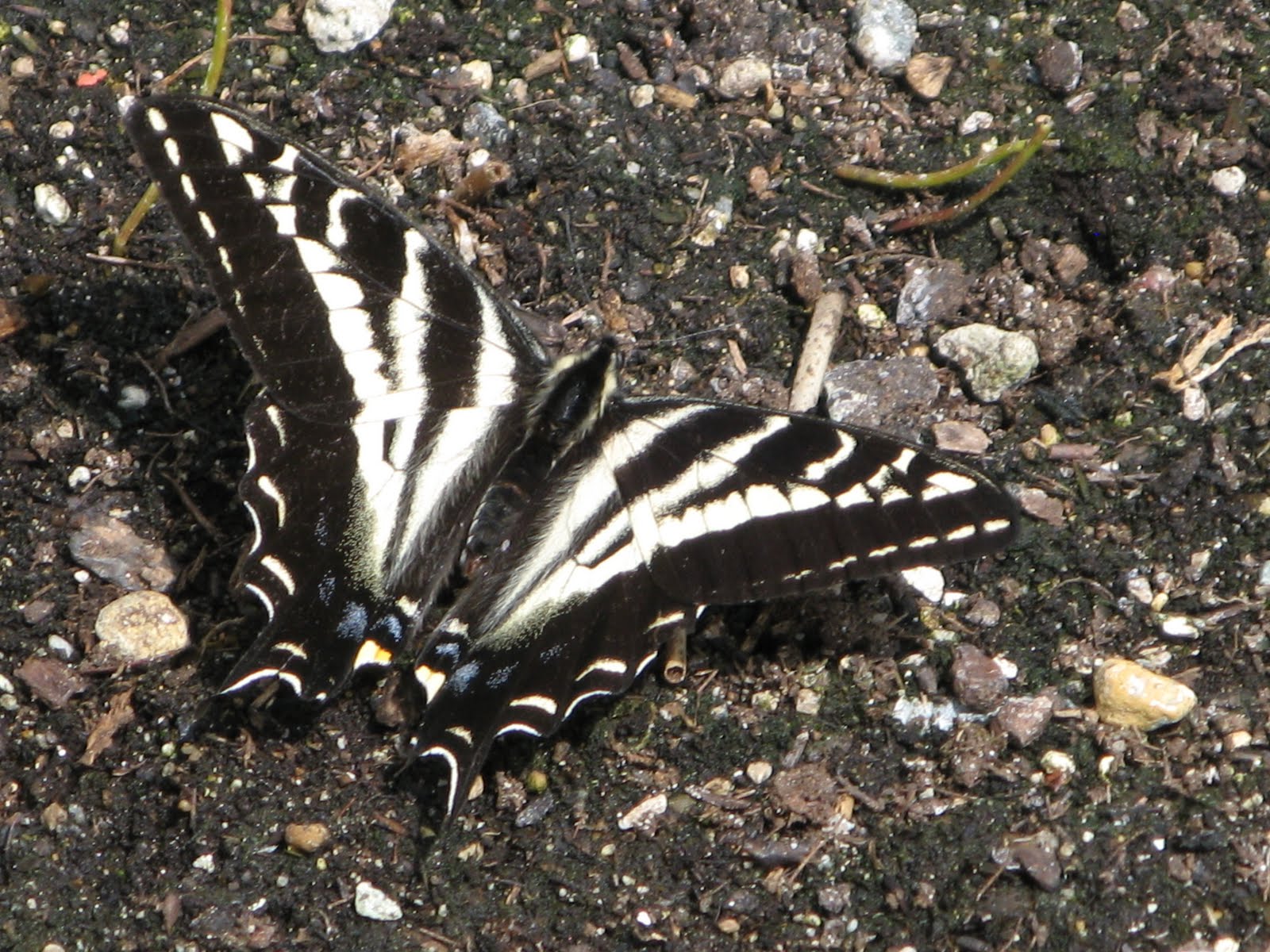
Coastal BC Insects: Pale Tiger Swallowtail Butterfly

Pale tiger Swallowtail Butterfly

The Pale Tiger Swallowtail is another large butterfly common to our coastal region in British Columbia. It's similar to the Western Tiger Swallowtail but has a much lighter appearance.

The Swallowtails appear later than the Mourning Cloaks. My first sighting this year was in mid-May and they stay through late-July.

The forewings are a pale yellow with black edges and bands radiating downward from the top. The hindwings have the distinctive pointed tails, much like the forked Barn Swallow’s tail. Supposedly, the tails evolved as a protective mechanism. If grasped by birds in flight, they will detach and allow the butterfly to escape and survive.
Like most butterflies, it lives on flower nectar. The larvae have more specific dietary needs. Eggs are laid on willow, poplar, sycamore, or alder trees so when they hatch their preferred food is readily available. We have lots of alders in our logging slashes, so that makes them prime Swallowtail breeding territory.

The larvae of the Pale Tiger Swallowtail eat foliage of woody plants then turn into pupa to wait out the winter. Butterflies emerge in the spring to enjoy the sweet nectar of blooming flowers, and start the mating and egg laying cycle all over again.

The males have an interesting behaviour called mud-puddling. They use small puddles and muddy ground to get moisture and nutrients from the damp soil. Recently, I found two butterflies in my garden doing just that. Here's a short video of their dance-like endeavor.

When I took the video I didn't know the purpose of their activity. Now, with a little research I've learned something new about the world around me. Some online resources I use for insect identification include:
E-Fauna BC -- Electronic Atlas of Wildlife in BC Insects and Spiders of BC -- Picture Gallery by Terry Thorman Butterflies and Moths of North America -- includes maps InsectIdentification.org -- includes a handy identification tool Bug Guide -- US and Canada Google -- using an image search 
Have you learned something new lately? -- Margy