Friday, April 30, 2010

Double Barreled Watering

Several years ago I started growing potatoes on the hill above our cabin. There wasn't much soil up there, but over the years thanks to composting and carrying some peat and manure up the hill, I've built up a nice little plot. A big drawback, however, is that it's a long ways above lake level and water in buckets is VERY heavy. Even though we got lots of rain in the spring, summer can get pretty dry.

Soon after starting my hillside garden, my good friend John designed a water barrel and rain catchment system. Because of the hilly location, he could install the system higher on the hill and gravity would feed a hose for easy (if a bit low in pressure and slow) watering.

A heavy duty plastic tarp is suspended between three trees. A 2X4 angles the tarp towards a large funnel into the top hole of a 55 gallon plastic barrel. It has remained in place through many wind storms over the last three years. Then this last month, John upgraded my system by adding a second storage barrel.

The two barrels are connected by a hose at the bottom (click the picture to the left for a better view). As the first barrel fills, the second barrel follows suit. This was a fairly easy expansion. The hose attachment to the first barrel didn't even have to be altered. Just as the water level rises equally between both barrels, the outflow draws equally between them. Now when it gets dry this summer I'll have twice the watering power with my "double barreled" watering system. Thanks so much John. -- Margy

Thursday, April 29, 2010

Varied Thrush

This spring a new visitor came to the cabin. At first I thought it was a robin, but on closer inspection I identified it as a Varied Thrush.

It first appeared along the cliff, hopping from one grassy spot to the next, never close enough for a good shot.

A Varied Thrush is related to a robin. They live in the Pacific Northwest in wet, coniferous forests. They eat insects (probably a lots of those on the grassy outcrops this time of year), fruit and acorns. Logging of mature forests has limited their range. Maybe that is why he (she?) appeared near the cabin. They just harvested the hills behind us, maybe destroying it's natural habitat or nesting site. -- Margy

Wednesday, April 28, 2010

Introducing Pacy at "Pacy Crochets"

This week for Wednesday Friends Day I would like to introduce Pacy and her blog Pacy Crochets.

Pacy and I are fairly recent followers of each other. I'm not sure who found whom, but it has been great. We have lots of interests in common, one of which is crocheting.

Pacy lives on five acres in Missouri. In some ways I'm envious of all that land to work with, but on the other hand, a floating garden is pretty quick to weed and care for. On the homestead they have llamas named Chili and Sassy and like my friend Margaret in Powell River, Pacy also raises chickens.

In addition to Pacy's blog, she also has a website. One page has a great idea for recycling plastic grocery bags. You can cut them up and crochet them into a variety of products. Click here to check it out.

Pacy has been blogging since July 2009 about sewing, weaving, gardening, living a simple life and, of course, crocheting. Here are a few of my favourites:

Stop on by and visit my friend Pacy. She'll "hook" you in more ways than one. -- Margy

Tuesday, April 27, 2010

Night Ferry

The ferry between Powell River BC and nearby Texada Island runs day and night, transporting residents and visitors alike.

When the 7:15 p.m. ferry comes in from Comox (the lights in the distance) on Vancouver Island, the Island Princess to Texada hovers off the breakwater waiting to pick up passengers who want to complete their journey home. Isn't she a beautiful sight? -- Margy

Monday, April 26, 2010

Powell River Books on Smashwords

Powell River Books strives to keep up with changes in the publishing industry. Apple has released their long awaited iPad and among its many uses is as an ebook reader.

Wayne's books are already available on Amazon.com for the Kindle. And yes, there is a free Kindle app for the iPad, but many users will want to make their ebook purchases at the iBook store. Consequently, all of Wayne's books are now available through Smashwords.

Smashwords is a free ebook publishing and distribution platform. Authors prepare a Microsoft Word .doc file of their book and upload it to the Smashwords website. The author maintains all rights to his or her work, but Smashwords helps them distribute their books to online sellers such as Barnes & Noble, Kobo, Sony, Amazon and Apple. They also sell ebooks in a variety of formats at their own website. Check it out for more information or to browse the many books they have to offer.

One drawback to Smashwords ebooks is that they do not include pictures, they are text only. For this reason, Wayne has maintained his complete text and picture Kindle versions at Amazon. So if you are an iPad user and want the Coastal BC Stories in their original format, you can download the free Kindle app for your iPad and have the best of both worlds. -- Margy

Sunday, April 25, 2010

Sumptuous Shrimp Shack

When we are in Bellingham we often drive to Whidbey Island to visit the Naval Base. And as it happens on most road trips, we get hungry. After conducting our business we head north on State Highway 20. Between the Deception Pass State Park and Campbell Lake on Fidalgo Island there's the small but mighty Shrimp Shack.

The full name is Sweet D's Shrimp Shack. It's owned and operated by Dieter and Laurel Drews and has been serving up seafood to hungry locals and visitors since 1973. You can purchase your seafood fresh to take home or have it prepared to order from their takeout window. No longer a seasonal eatery, you can now enjoy their seafood delights all year long.

Fresh seafood choices include shrimp, prawns, crab, lobster, oysters, clams and fish. They also have alligator and elk as unique options. Their takeout menu includes burgers, oyster burgers, seafood baskets and ice cream for dessert. Wayne and I picked the oyster dinner basket with four large fried oysters and fries. We shared one order with a pop to hold us over for the rest of the trip home.

After you place your order at the window, they prepare your food as requested. A loud speaker lets you know when its ready to pick up. Dining is outdoors on picnic tables or inside your vehicle in inclement weather. Either way it's a taste treat you shouldn't miss. -- Margy

Sweet D's Shrimp Shack
6168 Highway 20
Anacortes, WA
360-293-2531
www.shrimpshack.us

Friday, April 23, 2010

Forest Trail

Last week we went on a quad ride to Tony Lake where I discovered elk munching greens in the logging slash and hail preserved under the forest canopy.

As I walked away from the Tony Lake campsite, I was immediately engulfed by large second growth trees. They've been reaching for the sky for almost a hundred years now. Down below it stays cool and moist thanks to an almost complete sky covering, with just enough sun peaking through to make everything grow green and lush.

It's always beautiful whether you look down or up. -- Margy

Thursday, April 22, 2010

Strawberry Jam

Even though it isn't strawberry season up the lake, it is in sunny Southern California. Our market had quarts of ripe berries on sale for $1.98. I picked up two. One we enjoyed fresh, the other I made into strawberry jam.

I used Certo fruit pectin and the quick cook method. I didn't use all of the fruit called for in the recipe so I cut everything in half. I know you have to be very careful doing that. My jam didn't jell the first time, so I had to reprocess it. I'm not sure if it was because I cooked it too long after the pectin was added or if it just needed more pectin. But after I reprocessed the batch with the remaining half packet of pectin, it it jelled fine. Here is the recipe I ended up with:

Strawberry Jam
(makes about 4 half-pints)

2 cups prepared strawberries (1 qt raw)
4 cups sugar
2 tablespoons lemon juice
1 packet (box) CERTO Fruit Pectin

While I prepared the fruit, I brought water in my canning pot to a boil. To sterilize everything, I put clean half-pint (250ml) jars in the boiling water and the screw bands and lids in a separate pan covered with the boiled water.

To make it easier to mash the berries, I diced them after washing and hulling. Then I used my wire whisk to lightly crush them to get the juices flowing. The berries went into a large cooking pot along with the sugar. I brought them to a rolling boil, stirring constantly over high heat. Next I added the lemon juice followed by the pectin, still stirring.

Once it came back to a rolling boil I cooked it for exactly one minute. At this point, the jam will still be very liquid. I removed it from the heat and let it stand for 5 minutes before skimming the scum that forms on top. It isn't bad for you, it just doesn't look nice.

I got my canning jars out of the hot water and let them drain. They need to be hot for the filling process. I filled the jars to 1/8" from the top and wiped the rims and sides clean. I covered them with the self-sealing snap lids. Then the screw bands went on until finger tight. The jam filled four half pint (250 ml) jars with a little bit extra for the fridge.

All four sealed jars went into the hot water bath covered by 2" of water. After it got back up to a rolling boil (with the lid on) I timed it for 10 minutes. When done, the jars came out of the water bath to cool. I heard the four distinctive snapping sounds as the seals set. Now we have an alternative to the blackberry jam I made last summer.

Speaking of Southern California, they had a "jamming session" down on the Little Homestead in the City. Check out their wonderful blog and website. They have turned a city lot in Pasadena, California, into an urban homestead. As a part of their outreach program they went to a local school to teach students how to make strawberry jam. What a wonderful experience! Head on over to their blog and check it out. -- Margy

Wednesday, April 21, 2010

Introducing Lloyd at "Lloyd's Blog"

This week for Wednesday Friends Day I would like to introduce Lloyd and his blog aptly titled Lloyd's Blog.


Lloyd found me (rather than the other way around) through a post about my floating garden. Last January he summarized the post and included it on his blog. During one of my regular checks I discovered the link and Lloyd's wonderful blog.

Lloyd lives in California's Bay Area. It's a beautiful location to live and headquarters his small book publishing company. You can read more about it at his website called Shelter Online. He publishes his own books about building/architecture and fitness. He also offers other quality books on the same subjects.

One of Lloyd's books is Builders of the Pacific Coast. Of course that caught my eye because of where I live in Powell River. It's a beautiful full colour collection of distinctive buildings, many of which are in BC. Lloyd has personally traveled throughout the region to meet the builders and see their handcrafted structures. Several pages of text, photographs and drawings are used to highlight the unique abodes. While the majority of the homes and cabins are land-based structures, there was one floating home, a boat modified to anchor temporarily on pilings.

Lloyd has been blogging since February 2005 so there are lots of posts to choose from. Some of his topics follow his personal adventures. Others are a compilation of unique posts he has discovered across the web and world. Here are a few of my favourites:

You can also find Lloyd on Twitter as lloydkahn or shelterpub and on Facebook as Shelter Publications. He's really linked in. Why not give my friend a shout. -- Margy

Monday, April 19, 2010

Giving Beans and Peas a Head Start

Because of limited space in my floating garden, I grow lots of things in pots on the cabin deck. That's where you'll find my potatoes and tomatoes. Last year I successfully grew Snow Peas in a large pot with a homemade trellis. This year I'm going to move my green beans to a pot as well. That will save garden space for my annual asparagus, strawberries and herbs, and my seasonal carrots, beets, onions, spinach, lettuce, chard and radishes.

I've had problems getting beans and peas to sprout directly in the soil.
This year I decided to try using potting mix in cardboard egg cartons. To give the seeds a head start, I soaked them in water until they started to swell. I put one seed in each egg cup and covered it with soil. I added enough water to cover each section and a little extra in the bottom to soak up into the cardboard cartons.

To give the sprouts a warm moist home, I put the egg carton containers in a plastic tray. The cheapest I found were cat litter pans at about $4 each on sale at Canadian Tire. Four half size egg cartons fit in each tray. Then I cut off the bottoms of gallon milk cartons. Each half egg carton fit snugly under it's own plastic "hothouse."

I started twelve Snow Peas and twelve Scarlet Runner Pole Beans with lovely red flowers and tasty pods. That's more than I need for my two 23" diameter pots, but sometimes not all of my seeds sprout. Just a little extra insurance if you know what I mean. I put the plastic tray of mini-hothouses near the sunny window of our condo. They'll stay there unattended for a week until we can return from a trip the States.

APRIL 19 UPDATE: My little hothouses were too moist. When I returned, only two of the beans had sprouted. The rest moulded. I think it would have been better to give them a little air each day or maybe less water to start with.

I bought a wrought iron trellis at Canadian Tire for $19.99 that fit inside my blue barrel planter (click the picture for a better view). For extra climbing attachments and support, I added two 1X1's and tied a string lattice. Wayne drilled holes in the side of the barrel and secured everything with wire. I transplanted my two bean plants. For the remainder, I put new seeds directly in the soil. Now all I need are a few warm sunny days between the spring showers to get them going. - Margy

Saturday, April 17, 2010

Wood Stove Maintenance

Since we use our Kozi wood stove almost 24/7 during the winter, it needs maintenance and cleaning about every two months. We've been good about going on the porch roof and cleaning out the outer section of the pipe, but I'm embarrassed to say that we haven't cleaned the inside section since the beginning of the fire season last fall.

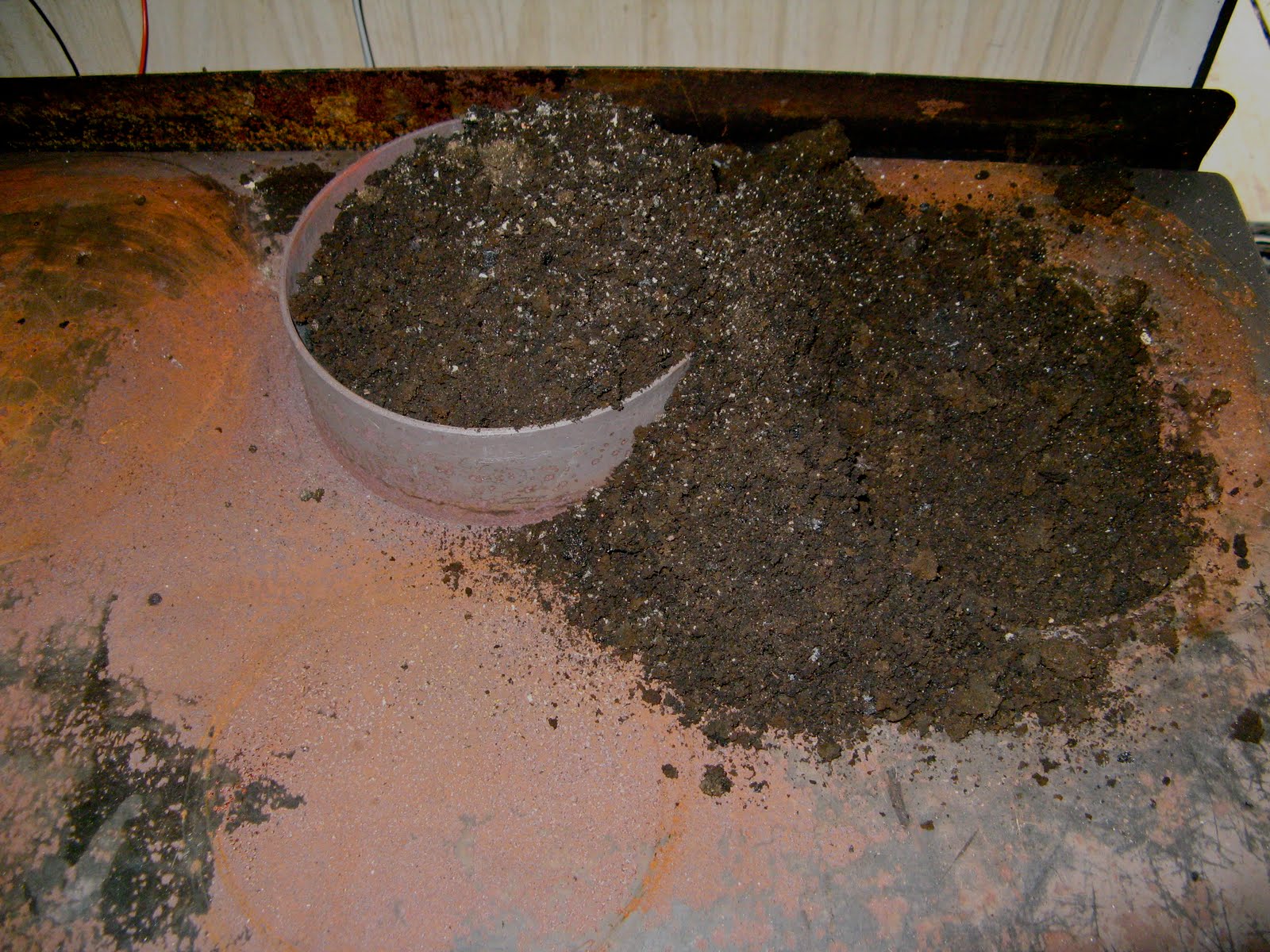
The first hint that creosote is building up in the chimney pipe is smoke coming out of the fire box door when it is opened. So when this happened again last week, we picked a fair day to let the fire die out to do the deed. As you can see in the first picture, tapping the pipe dislodged so much creosote that it filled the smoke shelf and pipe connector.

First we took down the inside pipe and removed the creosote adhering to the inside walls. A little newspaper on the floor helped keep the mess contained. When everything was done, here is what I saw. It seemed like quite a bit, but I guess I shouldn't have been surprised after so much use over the winter and early spring.

Last time we cleaned the pipe we noticed a small amount of smoke coming out through a joint in the pipe near the ceiling. We decided to seal the problematic junction with some Rutland "Seal it Right" to provide a better draft up and out of the chimney. If you would like more information on this subject, I found a good article by The Gas Man at Epinions.com. So far it has remained sealed with no further problems.

Chimney cleaning involves some disassembly both indoors and out, but it doesn't take long and the results provide for safer and more enjoyable fires. Play the video clip below to take a look at ours.

video
And yes, that is the USC Band playing Tusk (a personal favourite for Wayne) in the background. -- Margy

Friday, April 16, 2010

Fog Rise

Yesterday was warm and sunny, in the evening it rained and overnight it cooled down - prime conditions for a foggy morning.

Sunrise over Goat Island was at about 9:00 a.m. The rays were just visible through the hazy layer.

And then about half an hour later it lifted and headed through first narrows. Here's a quick video of the last tendrils moving south.

video

Thanks for stopping by. -- Margy

Wednesday, April 14, 2010

Signs of Spring

I am sorry to say that my Friends Day Wednesday post isn't ready. Instead, I decided to share a few signs of spring up my way.

Wild berries in bloom.

Roadside posies (do you know what they are called?). UPDATE: kateR correctly identified it as Purple Dead Nettle. It is a member of the mint family. When I first saw it as a young green plant I thought it was mint. It is listed as a tenacious weed, but is supposed to be edible and has herbal properties.

Mossy glens. What's spring like out your way so far? - Margy

Tuesday, April 13, 2010

Frozen Peas

Well, that's what they looked like to me. On our quad ride to Tony Lake last Saturday I found some very interesting snow, ice or frost formations while I was walking in the forest.

There were lots of little piles of round, peas-shaped ice. I thought maybe it was snow that melted and refroze, or maybe some type of hoar frost.

I tried a Google search and didn't come up with any answers. Do you know what this is called and how it is formed? I'd be very interested in getting some additional information. - Margy

Sunday, April 11, 2010

Tony Lake Tour

Yesterday Wayne and I took advantage of a warm sunny day to go quad riding. Our destination was the Knuckleheads Recreation Area so we could play in the snow before it's all gone. We started at our usual offloading spot on Dixon Road south of town. There's a nice wide turnout that holds our long double ATV trailer just right.

The first part of the ride was on Goat Lake Main. It's been a while since we've come this way and I was surprised at all of the recent logging. Things must be picking up in the forestry industry. It was interesting to see the different slash areas, some freshly cut, some with very small trees recently planted, and others with growing trees varying in age from 5 to 100 years. Forest management is very important to ensure it is a renewable resource.

At Tin Hat Junction we turned right on Stillwater Main and then left to the Knuckleheads. There's pretty good signage so we followed along until we reached A Branch. This is the smaller road leading up to the free public mountain recreation cabin, but well before that destination we found the snow we were looking for. It wasn't deep, but enough to keep us from making any more forward progress. We stopped by a small waterfall to enjoy our lunch.

On the way down we decided to take a side road to Tony Lake. I've always wanted to go there and this was a perfect time. Along the way we discovered seven Roosevelt Elk grazing in a recent slash. There's lots of open space for grass to grow and fewer trees to hide hunting cougars. They are magnificent animals. So stately and seemingly unafraid. Elk are very social. The group was split when we passed by. The group of four on the hill were waiting for their herd mates to return. Here's a short video.

video

At Tony Lake there was a small campsite that we had all to ourselves. Wayne tried a few casts, but the water is shallow with lots of underwater snags. I hiked around to take pictures in this lovely spot. We took t a different way out to return to Goat Lake Main. Even on such a beautiful day we saw very few people in the back country. What a wonderful way to relax and enjoy nature. I invite you to come share in one of British Columbia's best kept secrets. -- Margy

Friday, April 09, 2010

Sunrise Over Goat Island

This week the weather has been a mix of sun, clouds, wind, rain, hail and snow. Is this really spring?

One morning I was rewarded with a beautiful sunrise over Goat Island.

And that was the start to a nice, warm spring day. -- Margy